
Key Takeaways
- Series A due diligence typically reviews 80 to 100 documents across 8 categories: corporate, financial, tax, regulatory, IP, HR, commercial, and compliance.
- Most Indian startups have 30 to 40 of these ready when an investor first reaches out. The remaining 55 to 65 are built under time pressure during the DD window, which is when problems surface.
- Three categories kill the most deals: cap table reconciliation with MCA, transfer pricing documentation for cross-border revenue, and FEMA filings for any foreign shareholder or subsidiary.
- DD readiness is a 6-month preparation, not a 30-day scramble. Founders who treat it as a scramble lose 10 to 30 percent of valuation in renegotiation or lose the deal entirely.
- This checklist groups the 95 documents by category, urgency, and the specific compliance section each maps to.
Every Indian founder who has raised a Series A will tell you the same thing: the term sheet is the easy part. Due diligence is where deals quietly die.
I have walked through more than 40 DD processes for Indian startups in the last three years. The pattern is identical. A clean revenue story, a confident pitch, a signed term sheet. Then a lawyer opens the data room and finds three issues nobody flagged in 18 months of operations.
This is the 95-document checklist that investor counsel and DD consultants actually work through. Treat it as a 6-month preparation plan, not a 30-day scramble.
Why DD Readiness Is a 6-Month Project, Not a 30-Day Sprint
The numbers are sobering. Out of every 10 Series A term sheets signed in India, roughly 2 to 3 collapse during DD. Another 4 to 5 close at a 10 to 30 percent valuation cut from renegotiation triggered by DD findings. Only 2 to 3 close at full term sheet value.
The reason is simple. Most DD findings are not fraud. They are compliance gaps that accumulated over years of fast growth, where the founder prioritised shipping over filing. The fixes themselves often cost less than Rs 5 Lakh. But discovering them under DD pressure costs valuation, momentum, and sometimes the deal.
The checklist below is the playbook. Run it 6 months before you expect to raise. Fix what is broken before anyone asks.
The 8 Due Diligence Categories
Investor DD covers eight document categories. The total document count varies by stage and complexity, but for an Indian Series A round, expect roughly 95 documents across these eight categories:
- Corporate (12 documents): Incorporation, MCA filings, board governance
- Cap Table and Equity (10 documents): Shareholding history, ESOPs, share transfers
- Financial (15 documents): Audited financials, management accounts, projections
- Tax (12 documents): Income tax, GST, TDS, transfer pricing
- Regulatory and FEMA (10 documents): RBI filings, FC-GPR, FC-TRS, ODI, APR
- Intellectual Property (8 documents): Trademarks, patents, copyrights, assignments
- HR and Employment (15 documents): Offer letters, PF, ESOP grants, contractor agreements
- Commercial and Compliance (13 documents): Customer contracts, vendor agreements, sector-specific licences
Category 1: Corporate Documents (12)
- Certificate of Incorporation
- Memorandum of Association (current version, signed)
- Articles of Association (current version, signed)
- PAN and TAN of the company
- GST registration certificates (all states)
- Shop and Establishment registrations (all locations)
- MCA Form AOC-4 (last 3 years, with attachments)
- MCA Form MGT-7 (Annual Return, last 3 years)
- MCA Form DIR-12 (every director change, last 5 years)
- All board resolutions (last 3 years, signed and dated)
- Statutory registers (Section 88 Companies Act: members, debenture holders, charges, ESOP grants)
- List of related parties and related party transaction register
Category 2: Cap Table and Equity (10)
- Current cap table (Excel, fully diluted, with all option pools)
- Shareholder register matching MCA Annual Return exactly
- Every share allotment Form PAS-3 (with valuation reports)
- Every share transfer Form SH-4 (with FC-TRS where applicable)
- ESOP Plan document with Board and Shareholder approval resolutions
- ESOP grant register (every grantee, grant date, vesting schedule, strike price)
- SHA, SPA, and any other shareholder agreements (all versions)
- Convertible instruments outstanding (CCDs, CCPS, SAFEs if any)
- Founder share lock-in agreements (vesting, leaver provisions)
- Valuation reports for every issuance (Rule 11UA or Merchant Banker as applicable)
Category 3: Financial Documents (15)
- Audited financial statements (last 3 years, signed by auditor)
- Management accounts (monthly, last 24 months)
- Bank statements (all accounts, last 24 months)
- Loan agreements (all borrowings, including founder loans)
- Loan repayment schedules and current outstandings
- Working capital facilities documentation
- Trial balance, last 24 months
- Customer-wise revenue breakdown (last 12 months)
- SaaS metrics: ARR, MRR, churn, NRR, CAC, LTV (if applicable)
- Unit economics summary by product or vertical
- Financial projections (3-year, with assumptions)
- Use of funds document (for the proposed round)
- Internal financial controls policy document
- Auditor’s management letter (if any) and management response
- Any restatement notes from prior audits
Category 4: Tax Documents (12)
- Income tax returns (last 3 assessment years, with computation)
- Form 26AS (last 3 years)
- Any income tax notices received and responses filed
- GST returns: GSTR-1, GSTR-3B, GSTR-9, GSTR-9C (last 3 years)
- GST reconciliation: books vs returns (last 12 months)
- TDS returns (Form 24Q, 26Q, 27Q) and challans
- Transfer pricing study reports under Section 92D (if any international transactions)
- Form 3CEB filings (if applicable)
- Equalisation Levy compliance (Section 165, 165A if applicable)
- Professional tax registrations and returns
- Section 92CE Secondary Adjustment documentation (if any TP adjustment history)
- Any open or closed assessments, appeals, or settlement applications
Category 5: Regulatory and FEMA (10)
This is where cross-border startups lose deals most often. The list assumes you have at least one foreign shareholder or subsidiary.
- FC-GPR filings (every issuance to non-resident investors)
- FC-TRS filings (every share transfer involving a non-resident)
- Foreign Liabilities and Assets (FLA) return, last 3 years
- Form ODI (Part I and II) for every overseas subsidiary
- Annual Performance Report (APR) for each ODI, last 3 years
- SoftEx filings for software exports (last 24 months)
- External Commercial Borrowing (ECB) filings, if any
- Compounding orders received, if any FEMA contraventions were regularised
- Authorised Dealer bank correspondence on cross-border transactions
- Sectoral compliance certificates: SEBI, RBI, IRDAI, TRAI as applicable
For a deeper dive on FEMA penalties and timelines, see FEMA Compounding Penalties: What Indian Startup Founders Need to Know.
Category 6: Intellectual Property (8)
- Trademark registrations (all classes, all jurisdictions)
- Patent registrations and applications
- Copyright registrations (where filed)
- Domain name ownership records (all primary domains)
- Open source software inventory and licence compliance log
- IP assignment agreements from every founder, employee, and contractor
- Confidentiality agreements with vendors and partners
- IP disputes, oppositions, infringement notices (received or sent)
Category 7: HR and Employment (15)
- Organisation chart with full reporting lines
- Headcount summary (full-time, contract, part-time)
- All employment agreements (template plus key signed copies)
- Independent contractor agreements (with IP assignment clauses)
- ESOP grant agreements (signed copies for every grantee)
- Provident Fund registration and last 24 months of returns
- ESIC registration and returns (where applicable)
- Gratuity Fund or LIC Group Gratuity Scheme documentation
- Bonus Act compliance documentation
- POSH Act compliance: policy, IC constitution, training records, annual report
- Labour law compliance certificates (Shops Act, Contract Labour, Industrial Disputes)
- Employee handbook and key HR policies
- Termination records for last 24 months
- Any open or settled employment disputes
- Payroll register, last 12 months
Category 8: Commercial and Compliance (13)
- Top 20 customer contracts (signed)
- Customer concentration analysis
- Top 20 vendor and supplier contracts
- Master Service Agreements with key partners
- Distribution and reseller agreements
- Lease agreements for all premises
- Insurance policies (D&O, cyber, professional indemnity, property)
- Privacy policy and Terms of Service (current and historical versions)
- Data protection compliance: DPDP Act readiness assessment
- Any open litigation, arbitration, or pre-litigation notices
- Sector-specific licences (NBFC, fintech, healthcare, food, education as applicable)
- Government grants or incentives availed (Startup India tax exemption, Section 80-IAC certificates, MEIS, RoDTEP, etc)
- Sustainability, ESG, or BRSR disclosures (if applicable)
The Three Categories That Kill the Most Deals
If you can fix only three things in the next 90 days, fix these:
1. Cap table to MCA reconciliation. Pull your latest MGT-7. Open your cap table Excel. Compare every row. Mismatches in shareholder names, number of shares, or option pool size will surface in the first DD pass. The fix is to file the missing PAS-3, SH-4, or DIR-12 forms now, with delayed filing penalties under Section 446B (compounding under Section 441 if needed).
2. Transfer pricing for cross-border revenue. If you book revenue from a US, Singapore, or UAE subsidiary into the Indian entity (or vice versa), you have an international transaction under Section 92B of the Income Tax Act. You need a TP study report, a Form 3CEB, and Section 92CE secondary adjustment documentation if any prior TP adjustment exists. Most early-stage founders miss this entirely until DD. See Transfer Pricing for Indian Startups: The Plain English Guide for the basics.
3. FEMA filings for any foreign shareholder, subsidiary, or remittance. Every inward FDI needs an FC-GPR. Every transfer to or from a non-resident needs an FC-TRS. Every overseas subsidiary needs an ODI filing within 30 days and an APR every year. Missed filings under Section 13 of FEMA carry penalties up to 3 times the amount involved, plus Rs 5,000 per day. The first thing a DD lawyer pulls is the FC-GPR and APR list. If the dates do not match the transactions, the conversation gets uncomfortable fast.
The 6-Month DD Preparation Timeline
Month 1 (T minus 6): Categorisation. Build the 95-document data room structure. Assign one owner per category.
Month 2 (T minus 5): MCA reconciliation. Pull every MCA filing for the last 5 years. Compare against books. File backlog.
Month 3 (T minus 4): Tax and FEMA gap analysis. Engage a transfer pricing specialist if you have cross-border revenue. Run a FEMA filing audit.
Month 4 (T minus 3): HR and IP cleanup. IP assignment from every contributor. POSH compliance documented. ESOP grants reconciled to register.
Month 5 (T minus 2): Commercial contracts and licences. Customer concentration analysis. Sector licence renewals current.
Month 6 (T minus 1): Mock DD. A friendly lawyer or CA runs through the full 95-document list. Findings get fixed before the actual investor lawyer sees the room.
Frequently Asked Questions
Q1: Does this checklist apply to seed-stage startups too?
The structure does, but the depth scales with stage. A seed-stage startup might have 25 to 35 of these documents. A Series B startup will have all 95 plus additional sub-documents. Use the checklist as a maturity map, not a strict requirement at every stage.
Q2: How long does a full Series A DD process take?
In India, expect 45 to 90 days from data room access to the closing date, assuming no major findings. Each material finding adds 2 to 4 weeks. A DD process with 3 or more material findings often runs 120 to 150 days, by which time market conditions or term sheet validity can shift against the founder.
Q3: What is the most common DD red flag in 2026?
Cap table mismatch with MCA records, followed closely by missing transfer pricing documentation for cross-border revenue. Both come from fast-growth periods where filings lagged operations. Both are cheap to fix in advance, expensive to fix during DD.
Q4: Should I use a data room platform or share a Drive folder?
For Series A onwards, use a structured data room platform (Drooms, Intralinks, Datasite, or Ansarada). Indexed access, audit trails, watermarking, and granular permissions matter when 5 to 8 investor counsel teams are reviewing simultaneously. For pre-Series A, a well-structured Drive folder with the 8-category index is acceptable.
Q5: Who owns DD preparation in a startup?
The CFO or Head of Finance owns the financial and tax categories. The Company Secretary owns the corporate and cap table categories. The General Counsel or external counsel owns IP, commercial, and litigation. HR owns employment. The founder owns the timeline and coordination. If your startup does not yet have a CFO or CS, an external advisory firm should run the preparation.
Action Items This Week
- Run the DD Readiness Score tool to benchmark where you are today against the 95-document standard.
- Pull your latest MGT-7 from MCA and your cap table Excel. Reconcile every row.
- List every cross-border transaction in the last 24 months. Identify which need transfer pricing or FEMA filings.
- If you find more than 3 gaps, start the 6-month preparation timeline this week.
How A S Banka Advisors Private Limited Helps
We run pre-DD readiness audits for Indian startups planning a Series A or growth round in the next 6 to 12 months. The output is a category-by-category gap report, a fix roadmap, and a project plan to take your data room from 30 percent ready to 100 percent ready before the first investor call.
If you are 6 to 12 months from a fundraise, schedule a strategy session to map out your DD preparation.
Disclaimer: This article is for general information only and does not constitute legal, tax, or financial advice. Founders should engage qualified counsel for specific transactions. Regulatory provisions referenced are current as of May 2026.
Related Posts
How Are ESOPs Taxed in India for Startup Employees? A Founder’s Guide (2026)
Key Takeaways In India, ESOPs are taxed at two separate…
The Startup Founder’s March 31 Compliance Checklist: 10 Deadlines You Cannot Miss
March 31 is the most consequential date on every Indian…
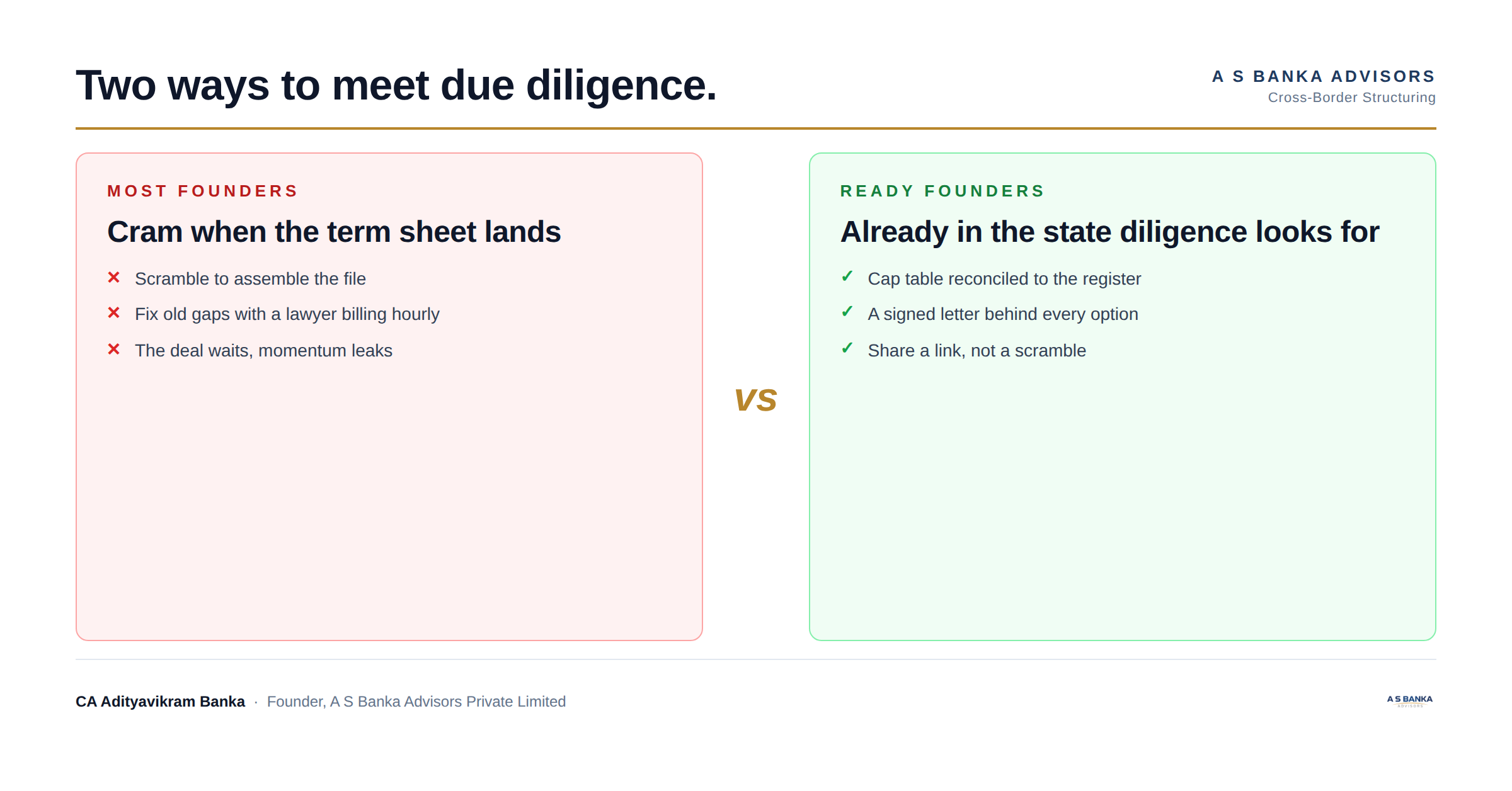
The Startup Due Diligence Checklist Indian Founders Should Run Before Investors Do
Key Takeaways Due diligence is a state, not an event.…