Key Takeaways
- A Delaware Flip moves the parent company to the US. A Reverse Flip moves it back to India.
- The Delaware Flip triggers Indian capital gains tax at an effective rate of about 14.95 percent on the share value at the time of swap, post the Finance (No 2) Act 2024 amendment. The headline rate is 12.5 percent LTCG, with a 15 percent surcharge cap on capital gains and 4 percent cess on top.
- The Reverse Flip became a real option after the IFSCA framework (2024) and Finance Act amendments (2024-25), but still triggers Indian tax in most cases.
- Most CAs run the structuring math but skip the 3-year cumulative cost comparison.
- The right answer depends on where your customers are, where your team is, and where your eventual buyer or acquirer sits.
Delaware Flip vs Reverse Flip: The Tax Math Nobody Does for Your Indian Startup
Every Indian founder eyeing global markets eventually hears the same advice: “Do a Delaware Flip.” A few years later, the same founder hears the opposite: “You should do a Reverse Flip back to India.”
Both pieces of advice can be right. Both can be expensive if you do not run the actual tax math.
This guide walks through the structures, the real tax math under the current Income Tax Act 2025 and FEMA framework, and a decision matrix for Indian startups choosing between the two paths.
What Is a Delaware Flip?
A Delaware Flip is a corporate restructuring where founders set up a new parent company in Delaware (USA) and swap their existing Indian company shares for shares in the new US parent. The Indian company becomes a subsidiary of the US parent.
Why founders do it:
- US investors prefer Delaware C-Corp structure (familiar, predictable, established case law)
- Easier to issue ESOPs to US-based employees
- Cleaner path to US IPO
- Better access to YC, Tiger, Sequoia US, and other US-led funds
What Is a Reverse Flip?
A Reverse Flip is the opposite. Founders who previously did a Delaware Flip move the parent company back to India. The US parent is collapsed (or becomes a subsidiary), and an Indian company holds the global structure.
Why founders do it:
- Indian IPO valuations have outperformed US IPOs for B2C startups (Zomato, Paytm, Nykaa playbook)
- SEBI’s framework now permits domestic listing for Indian-rooted businesses
- IFSCA and Finance Act 2024-25 created a structured path for the inbound move
- Domestic VC funding pools have grown enough to anchor late-stage rounds
The Delaware Flip Tax Math (Outbound)
Let’s run a real scenario.
Setup: Indian startup valued at Rs 100 Cr. Founders own 60 percent. They want to set up a Delaware C-Corp parent.
Step 1: Share Swap
- Founders transfer their Indian company shares to the new Delaware parent
- In return, they receive shares of the Delaware parent
Tax Trigger: The share swap is treated as a transfer under Section 47 read with Section 9(1)(i) of the Income Tax Act 2025. It is NOT exempt unless specifically structured.
Tax Calculation (post Finance (No 2) Act 2024 rates, effective for transfers on or after July 23, 2024):
- Founder’s share value at swap: Rs 60 Cr (60 percent of Rs 100 Cr)
- Original cost: Rs 1 Cr (assumed founder paid-up capital)
- Long-term capital gain: Rs 59 Cr
- LTCG at 12.5 percent (without indexation, on unlisted shares): Rs 7.38 Cr
- Surcharge at 15 percent (cap on capital gains under Finance Act 2022): Rs 1.11 Cr
- Health and education cess at 4 percent (on tax + surcharge): Rs 0.34 Cr
- Total tax: Rs ~8.82 Cr (effective rate 14.95 percent)
FEMA Trigger: The swap creates two reportable events. Founders must:
- File Form FC-TRS for the transfer of Indian company shares from resident founders to a non-resident transferee (the Delaware parent), under FEMA NDI Rules 2019
- Report the founder’s receipt of Delaware parent shares as an Overseas Direct Investment within 30 days, via Form FC under the FEMA (Overseas Investment) Regulations 2022
- Comply with annual APR filings on the ODI going forward
For a deeper dive on FEMA penalties for missed filings, see FEMA Compounding Penalties: What Indian Startup Founders Need to Know.
True Cost of the Flip: Rs ~8.82 Cr in tax, plus Rs 50-75 Lakh in legal and structuring fees, plus 4-6 months of compliance overhead. Total cost: roughly Rs 9.5-10 Cr on a Rs 60 Cr personal share value.
The Reverse Flip Tax Math (Inbound)
Now the opposite scenario.
Setup: US-headquartered startup with Indian subsidiary. US parent valued at Rs 500 Cr (post Series B). Founders own 40 percent. They want to move the parent back to India.
Path 1: NCLT-approved Cross-Border Merger
- The US parent merges into an Indian holding company under Section 234 of the Companies Act
- Founders receive Indian holdco shares for their US shares
Tax Trigger: Under current law, this is a deemed transfer. The exchange of shares is taxable in India for resident founders (CBDT clarification, August 2024).
Tax Calculation (same post Finance (No 2) Act 2024 rates):
- Founder’s US parent share value: Rs 200 Cr
- Original cost basis: Rs 5 Cr
- Long-term capital gain: Rs 195 Cr
- LTCG at 12.5 percent (without indexation): Rs 24.38 Cr
- Surcharge at 15 percent (cap on capital gains): Rs 3.66 Cr
- Health and education cess at 4 percent: Rs 1.12 Cr
- Total tax: Rs ~29.15 Cr (effective rate 14.95 percent)
Path 2: Inbound Restructuring via IFSC GIFT City
- Use the IFSCA framework (2024 amendments) to set up a holding entity in GIFT City
- Specific exemptions under Section 47 may apply for IFSC-registered entities
- Reduces but does not eliminate Indian tax exposure
True Cost of Reverse Flip: Rs 22-30 Cr in tax (depending on valuation and structuring path), plus Rs 1.5-2 Cr in legal and FEMA fees, plus 12-18 months of regulatory approvals.
The 3-Year Cumulative Cost Comparison
| Cost Driver | Delaware Flip | Reverse Flip (post-existing flip) |
|---|---|---|
| One-time tax cost (12.5% LTCG + 15% surcharge + 4% cess = 14.95% effective) | Rs ~8.82 Cr (founder LTCG on Rs 59 Cr gain) | Rs ~29.15 Cr (founder LTCG on Rs 195 Cr gain) |
| Legal and structuring fees | Rs 50-75 Lakh | Rs 1.5-2 Cr |
| Annual compliance overhead | Rs 25-40 Lakh per year (US filings, transfer pricing, FEMA) | Rs 15-25 Lakh per year (Indian compliance only) |
| Cross-border IP licensing complexity | High – requires arm’s length pricing under Section 92 | Low – all entities Indian |
| Time to complete | 4-6 months | 12-18 months |
| Reversibility | Possible but expensive (Reverse Flip) | Possible but expensive (re-flip) |
For founders structuring cross-border revenue between an Indian parent and a foreign subsidiary, see our Transfer Pricing for Indian Startups guide for the documentation requirements under Section 92.
The 4 Questions That Determine Your Answer
1. Where Are Your Paying Customers?
If 60 percent or more of your revenue comes from US enterprise contracts, the Delaware Flip becomes structurally cleaner. Customer onboarding, payment processing, and contract law all favour a US entity for US-led sales.
2. Where Will Your Eventual Buyer Sit?
If you are building toward a US strategic acquisition (Salesforce, Microsoft, Adobe), a Delaware C-Corp simplifies the deal. If you are building toward an Indian IPO (Zomato, Nykaa playbook), an Indian holding company is the right structure from day one.
3. What Stage Are You at Today?
Pre-Series A: structural decisions are cheap to reverse. Post-Series B: every flip costs founder dilution and tax outflow. The earlier you decide, the cheaper the structure.
4. What Is Your Capital Source?
If your lead investors are US-based VCs that mandate Delaware (YC, Tiger, Sequoia US, Accel US), you do not really have a choice. If your investors are Indian and India-focused (Peak XV India, Blume, Lightbox, Stellaris), staying Indian is the natural path.
The 3 Mistakes Founders Make on Both Sides
Mistake 1: Doing the Flip Reactively
Most founders do the Delaware Flip after a US investor demands it. By then, they have lost negotiating power. The investor has the term sheet leverage, and the founder pays the tax. Do the structuring decision proactively, before fundraising starts.
Mistake 2: Not Modeling the Reverse Path
Every Delaware Flip should be evaluated against the cost of a future Reverse Flip. If your IPO destination is India, a Delaware Flip can cost you Rs ~9 Cr today AND Rs ~29 Cr in 5 years (on the worked-example valuations above), at the current 14.95 percent effective LTCG rate.
Mistake 3: Trusting “Standard Structuring”
There is no standard Indian-startup-going-global structure. Each business has different IP, customer geographies, and exit assumptions. The lawyer who copy-pastes a Delaware Flip from a previous deal is doing you no favour.
The 4-Step Decision Framework
- Map your 5-year revenue geography. Where do you expect 70 percent of revenue to sit by Year 5?
- Identify your exit path. US strategic acquisition, Indian IPO, US IPO, or perpetual private?
- Run the 3-year cumulative tax model. Include the cost of the flip itself, ongoing transfer pricing, and the cost of unwinding if you change your mind.
- Match your structure to your investors, not your investors to your structure. Choose the structure that aligns with the funding pool you actually want to tap.
FAQ
Q1: Can I avoid the LTCG tax on a Delaware Flip?
Section 47 of the Income Tax Act 2025 exempts certain transfers (subsidiary to parent, mergers, demergers), but a founder-level share swap to a foreign parent does NOT qualify. The tax is real. Some founders use staggered transfers, gift-route structures, or HUF planning to optimize the timing, but they cannot avoid the underlying tax event.
Q2: Is the Reverse Flip really cheaper now?
Cheaper than 3 years ago? Yes, materially. The Finance (No 2) Act 2024 cut the LTCG rate on unlisted shares from 20 percent (with indexation) to 12.5 percent (without indexation), and the 15 percent surcharge cap on capital gains plus 4 percent cess takes the effective rate to about 14.95 percent. Cheap in absolute terms? No. The IFSC GIFT City framework reduces some friction, but the founder-level capital gain still triggers in most structures. Plan for Rs 15-33 Cr in tax exposure for any reverse move on a venture-backed company in the Rs 100-220 Cr founder-share-value range (applying the 14.95 percent effective rate to the gain, assuming a small founder cost basis).
Q3: How long does each take?
Delaware Flip: 4-6 months end to end (incorporation, share swap, FEMA filing, valuation report). Reverse Flip: 12-18 months (NCLT approval, RBI approval, US side wind-up, GIFT City registration).
Q4: Do I need different lawyers for each?
Yes. A Delaware Flip needs Indian counsel for ODI/FEMA AND US counsel for Delaware incorporation, securities compliance, and US tax. A Reverse Flip needs Indian counsel for NCLT, RBI, and IFSC approvals AND US counsel for the unwind. Single-jurisdiction firms typically miss critical issues.
Q5: What about the new IFSC route?
IFSC GIFT City offers some genuine tax advantages: no LTCG on certain transfers, dividend tax holiday for IFSC funds, and reduced compliance burden. It is most valuable for fund vehicles, not operating companies. For an operating startup, IFSC simplifies the move but does not eliminate the founder-level tax.
The Bottom Line
The Delaware Flip vs Reverse Flip decision is not about which structure is better. It is about which structure aligns with where your business actually is in 5 years. The math is brutal in both directions if you decide reactively. The math is manageable if you decide proactively.
The cheapest structure is the one you choose first and never change.
Need Help Modeling Your Specific Situation?
Every flip decision involves IP location, employee equity, customer contracts, and 3 different regulators. If you are evaluating a Delaware Flip or Reverse Flip for your startup, talk to A S Banka Advisors Private Limited. We model both routes and can tell you the actual tax cost in your specific situation.
Disclaimer: This article is for educational purposes only and does not constitute tax or legal advice. Tax positions are based on the Income Tax Act 2025 and FEMA framework as of April 2026. Always consult a qualified professional before structuring decisions.
Related Posts
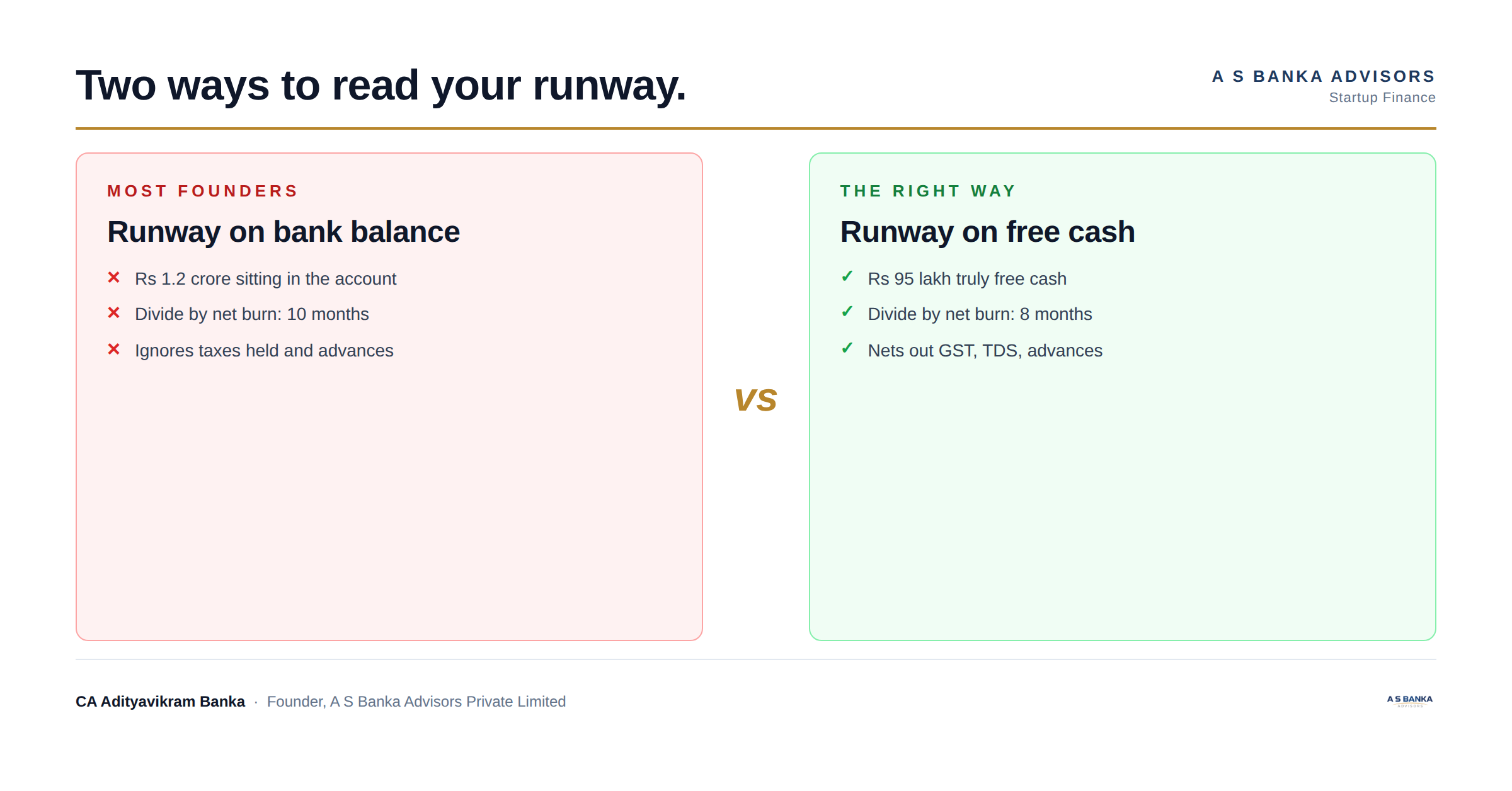
Burn Rate and Runway for Indian Startups: How to Calculate Both (and Why Founders Get It Wrong) in 2026
Key Takeaways Gross burn is the total cash you spend…
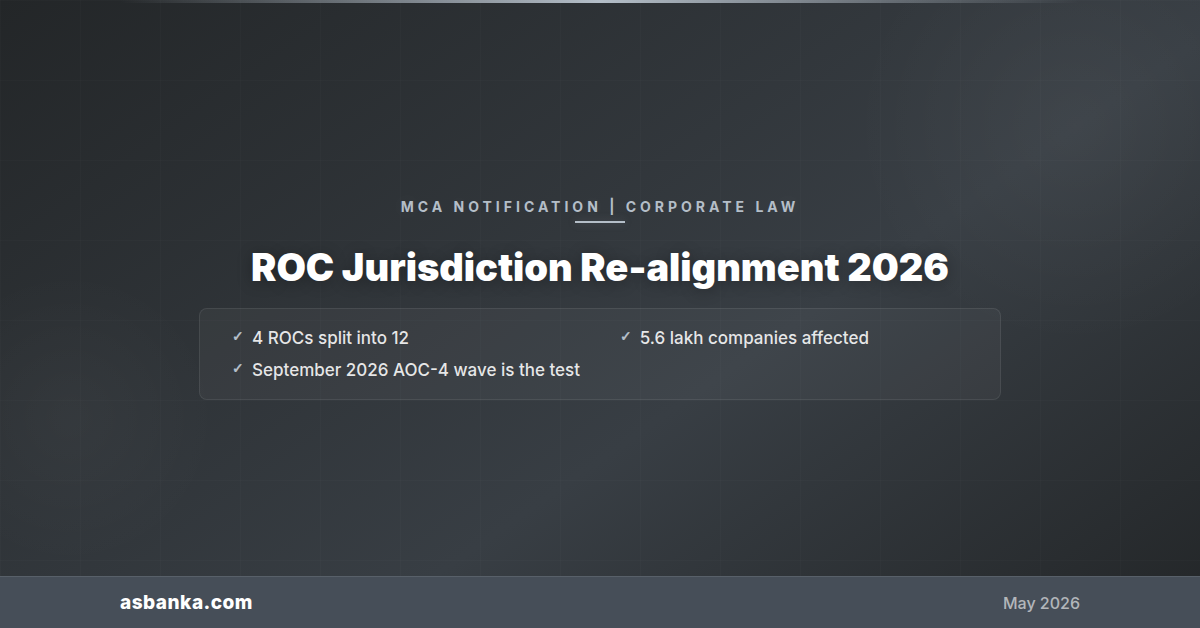
ROC Jurisdiction Re-alignment 2026: How Founders and Their CAs Should Use the V3 Master Data Window Before the September AOC-4 Wave
If you are a founder or a finance leader running…
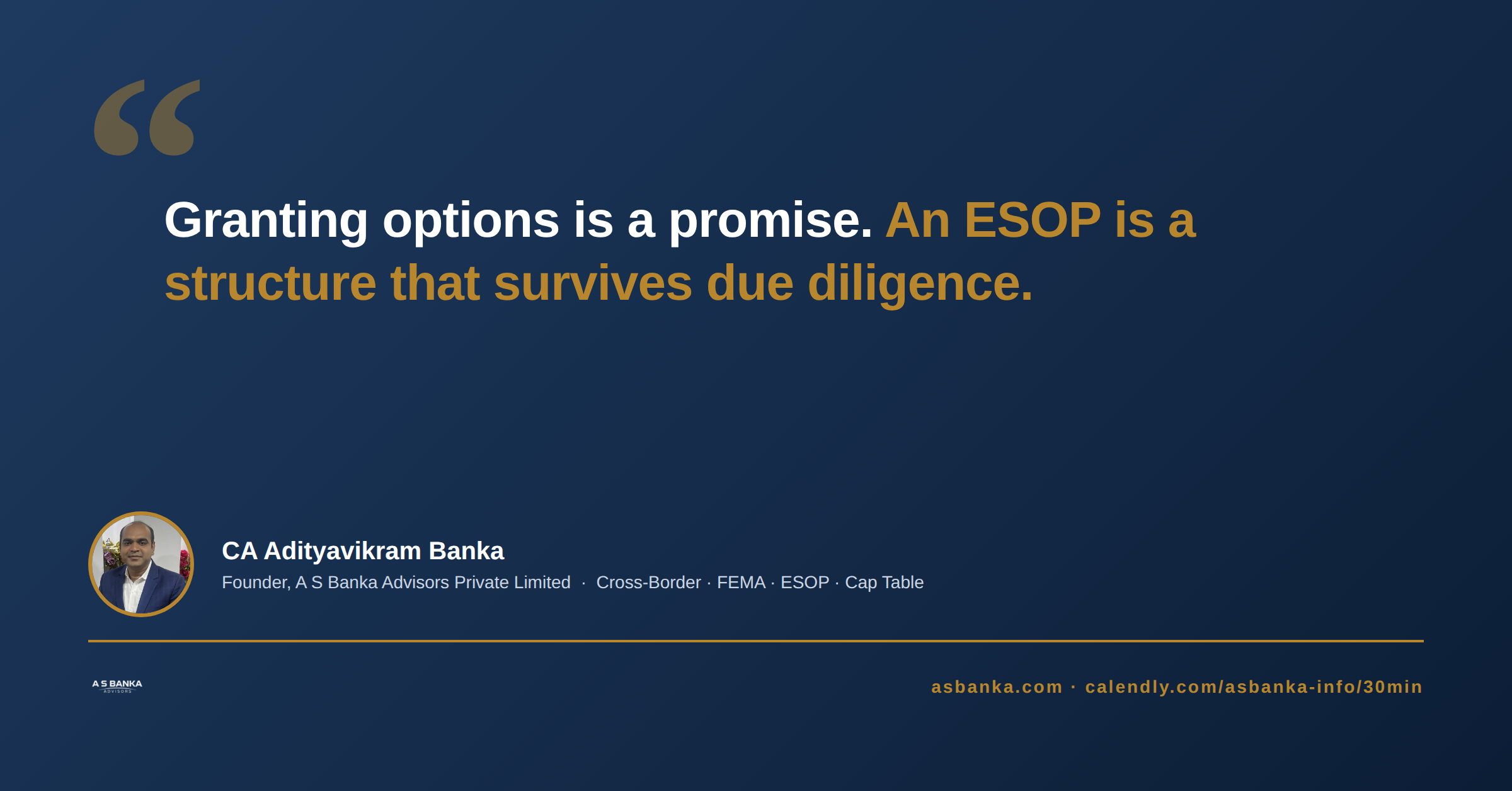
How to Set Up an ESOP for Your Indian Startup (So It Survives Due Diligence)
Key Takeaways Granting ESOPs and having a legally sound ESOP…