If you manage or sponsor an Alternative Investment Fund in India, SEBI’s 2026 Amendment Regulations (published April 21, 2026) have introduced three shifts that deserve more attention than the regulatory press has given them. Two of the three changes are strategic, not cosmetic. Acting in the next 30 days will save a scramble later.
What Actually Changed
The SEBI (Alternative Investment Funds) (Amendment) Regulations 2026 amend the parent 2012 AIF Regulations in three places:
- New Regulation 10(10A): SEBI now has the power to tag an AIF as an “inoperative fund” on conditions it will specify by operational circular. This is an enabling provision, a legal hook, not a finished framework.
- Regulation 29 (Distribution of Proceeds): Distribution is now expressly subject to conditions SEBI specifies from time to time. Static regulatory text has been replaced by a circular-driven mechanism.
- Regulation 10(c): The threshold has been revised from “two lakh” to “one thousand”. This is a drafting-level correction aligning with other SEBI provisions.
Why the Inoperative Fund Category Matters
An AIF in wind-down, a fund that has stopped drawing commitments, or a feeder that has completed its investment phase all sit in an awkward compliance zone today. They must still file quarterly, maintain reporting cadence, and carry the full burden of a live fund despite having no active deal flow.
Regulation 10(10A) is the enabling text for a lighter regime. Based on the analogous dormant-company provisions under Section 455 of the Companies Act 2013, we expect SEBI’s operational circular to specify a 12 to 24 month test: no fresh commitments, no new investments, no distributions for a continuous period. Funds that self-declare inoperative status are likely to move from quarterly filings to simpler annual declarations, with automatic reversal on resumption of activity.
Regulation 29 Is Now a Living Rule
This is the change that will bite fund managers who do not prepare. Until now, distribution provisions were locked into the regulation text. Amending them required a regulatory process. From April 21 onward, SEBI can update distribution conditions by circular. Any PPM that hardcodes current practice will be out of alignment the moment the first circular lands.
Side letters and MFN clauses that guarantee specific distribution mechanisms to anchor LPs are particularly exposed. If the SEBI condition conflicts with a locked-in side letter, the fund manager will be caught between regulatory compliance and contractual commitment.
What to Do in the Next 30 Days
The operational circular on inoperative funds has not yet been issued, but preparation does not need to wait. Start with these steps:
- Draft a PPM addendum with a risk-factor paragraph on potential inoperative-fund tagging and a forward-looking compliance clause covering Regulation 29 conditions.
- Identify internally which funds could qualify as inoperative under the predicted criteria. This is an internal exercise, not a filing, but the analysis informs your LP communication when the circular drops.
- Review side letters and MFN clauses. Flag any distribution mechanism that is hardcoded in a way that could conflict with a future SEBI condition. Engage LP counsel early on consent discussions.
- Add an “Inoperative Fund Status (Y/N)” field to your quarterly reporting templates now, so fund administrators are not rebuilding systems in 30 days.
- Brief your trustees at the next board meeting with a one-page compliance note covering the three changes and the expected operational circular.
What This Means for Your Startup if You Raised via an AIF
If your company took capital from a Category I, II, or III AIF, the fund’s compliance posture affects your governance rights. An upstream fund tagged inoperative can affect board nominee rights, drag and tag mechanics, and the fund’s ability to participate in future rounds. Founders should ask the manager directly whether their fund is likely to fall into the inoperative category in the next 12 months, and what the plan is for post-tagging governance continuity.
Download the Full Carousel
We have put together a compact 8-slide carousel summarising the Amendment, the predicted inoperative-fund criteria, and the 30-day compliance checklist. Download the full SEBI AIF Amendment 2026 carousel PDF.
Need Help with the PPM Refresh?
If you are an AIF sponsor, fund manager, or sponsor-LP advisor working on the 2026 compliance refresh, the first 30 days are the window. A S Banka Advisors Private Limited has supported AIF managers, investment banks, and fund administrators on PPM refresh, side-letter review, and compliance calendar rework. Book a quick call to discuss how the Amendment affects your PPM timeline and LP communication plan.
Related Posts
DPT-3 by July 31, 2026: What the MCA Fire Relief Actually Gives Your Company (and What It Does Not)
If you run a private limited company, your June 30…
ESOP vs Phantom Stock: Which Equity Plan Is Right for Your Startup?
You want to retain your best people. You've heard about…
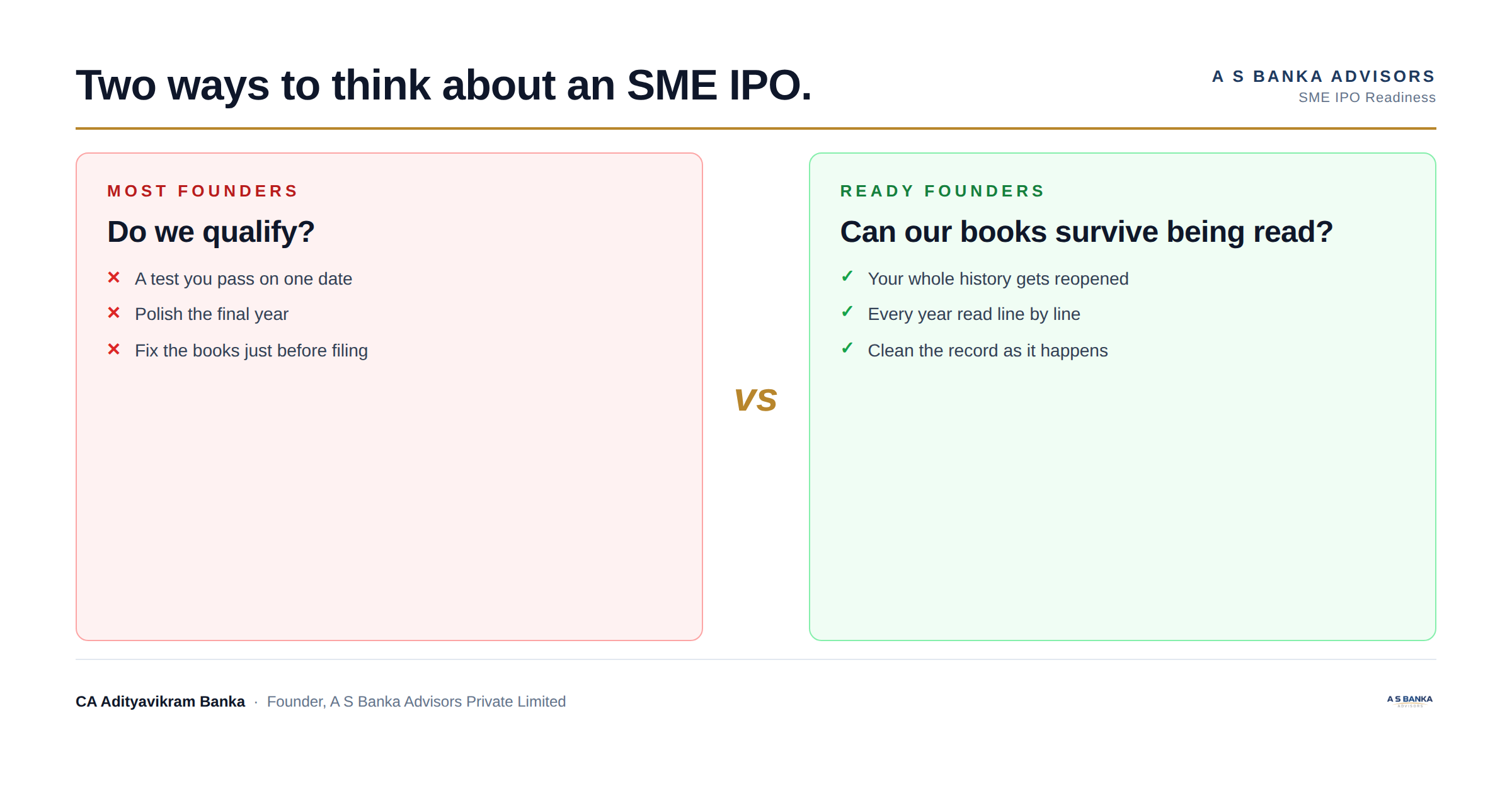
SME IPO Readiness in India: What Your Books Have to Look Like Before You File (2026)
Key Takeaways SME IPO readiness is a financial hygiene problem,…