
Key Takeaways
- ESOPs in India are not taxed at the time of grant. The tax event happens later.
- At exercise, the difference between Fair Market Value (FMV) and exercise price is taxed as perquisite (salary income) at the employee’s slab rate.
- At sale, capital gains tax applies on the difference between sale price and FMV at exercise.
- Employees of eligible startups can defer the perquisite tax for up to 48 months under the startup deferral provisions.
- Phantom Stock avoids the exercise-stage tax trap entirely, making it a strong alternative for early-stage startups.
Why ESOP Taxation Catches Founders Off Guard
Most founders think about ESOPs as a retention tool. Grant options to key employees, they vest over time, everyone is aligned with the company’s growth.
What they don’t realize: the tax structure of ESOPs in India creates a cash flow problem that can turn your “reward” into a financial burden for the very people you’re trying to retain.
Here is how it plays out. A CTO exercises their options, gets hit with a tax bill they didn’t expect, and suddenly the equity “reward” has cost them real money, for shares they can’t sell.
This guide breaks down exactly what happens at each stage, with real numbers, so you can make informed decisions about how to structure equity for your team.
The 3 Tax Events in an ESOP Lifecycle
ESOP taxation in India has three distinct stages. Understanding each one is critical before you make your first grant.
Stage 1: Grant (No Tax)
When you grant stock options to an employee, no tax event occurs. The employee receives the right to buy shares at a predetermined price (the exercise price) in the future. This is simply a promise, not a transfer of value.
There is nothing to report, nothing to pay, and nothing to file at this stage.
Stage 2: Exercise (Perquisite Tax)
This is where most founders and employees get surprised.
When an employee exercises their options (pays the exercise price and converts options into actual shares), the difference between the Fair Market Value (FMV) of the shares and the exercise price is treated as a perquisite under salary income.
This perquisite is taxed at the employee’s income tax slab rate, which can be as high as 30% (plus cess and surcharge).
Example:
- Exercise price: Rs 100 per share
- FMV at exercise: Rs 500 per share
- Number of options exercised: 1,000
- Perquisite value: (Rs 500 – Rs 100) x 1,000 = Rs 4,00,000
- Tax at 30%: Rs 1,20,000
- Total cash outflow for the employee: Rs 1,00,000 (exercise cost) + Rs 1,20,000 (tax) = Rs 2,20,000
The employee now holds shares worth Rs 5,00,000 on paper, but has spent Rs 2,20,000 in cash, for shares that typically cannot be sold because there is no liquidity event (no IPO, no acquisition, no secondary sale).
Stage 3: Sale (Capital Gains Tax)
When the employee eventually sells the shares (at IPO, acquisition, or secondary sale), capital gains tax applies on the difference between the sale price and the FMV at the time of exercise.
The holding period for capital gains starts from the date of exercise, not the date of grant or vesting.
| Type | Unlisted Shares (Startups) | Listed Shares (Post-IPO) |
|---|---|---|
| Long-Term (LTCG) | Held > 24 months: 12.5% | Held > 12 months: 12.5% (above Rs 1.25 lakh) |
| Short-Term (STCG) | Held ≤ 24 months: Slab rate | Held ≤ 12 months: 20% |
Example (continuing from above):
- FMV at exercise: Rs 500 per share
- Sale price (3 years later): Rs 1,200 per share
- Capital gain: (Rs 1,200 – Rs 500) x 1,000 = Rs 7,00,000
- Tax (LTCG at 12.5%): Rs 87,500
Total tax paid across both events: Rs 1,20,000 (perquisite) + Rs 87,500 (LTCG) = Rs 2,07,500 on a total gain of Rs 11,00,000. That’s an effective tax rate of approximately 18.9%.
But here’s the catch: the perquisite tax was paid years before the capital gains event. Your employee paid Rs 1,20,000 in real cash for paper gains they couldn’t realize.
The Startup Deferral Provision
Recognizing the cash flow problem for startup employees, the government introduced a deferral provision for eligible startups.
If your company is recognized under Section 80-IAC (DPIIT-recognized startup), your employees can defer the perquisite tax on ESOP exercise until the earliest of:
- 48 months from the end of the relevant assessment year
- The date of sale or transfer of shares
- The date the employee leaves the company
This deferral doesn’t eliminate the tax. It pushes it to a point where the employee may have liquidity to pay it.
Important: To qualify, your startup must be recognized by DPIIT. The deferral provision is not available to employees of all companies. Confirm eligibility with your tax advisor under current rules.
The Cash Flow Trap: When ESOPs Punish Employees
Here’s the scenario I see play out regularly:
- Startup grants ESOPs at nominal exercise price (Rs 10 or Rs 100)
- Company grows. FMV reaches Rs 500-1,000 per share based on last funding round
- Employee wants to exercise (vesting period complete)
- Exercise cost + perquisite tax bill = Rs 2-5 Lakhs in cash
- No secondary sale available. No IPO timeline. Shares are illiquid.
- Employee either: (a) doesn’t exercise and risks losing unvested options on exit, or (b) exercises and takes a significant cash hit for shares they can’t sell
This is not a hypothetical. I’ve advised startups where senior engineers turned down equity exercises because the tax bill was larger than their monthly salary.
The equity “reward” became a financial disincentive.
ESOP vs Phantom Stock: The Tax Comparison
Phantom Stock (also called Stock Appreciation Rights or Shadow Equity) offers a fundamentally different tax treatment. For a detailed structural comparison, see our ESOP vs Phantom Stock guide.
| Parameter | ESOP | Phantom Stock |
|---|---|---|
| Tax at grant | None | None |
| Tax at exercise/vesting | Perquisite tax (slab rate, up to 30%+) | None (no exercise event) |
| Tax at payout | Capital gains (12.5% LTCG or slab rate STCG) | Salary income (slab rate) or bonus |
| Cash outflow before liquidity | Exercise price + perquisite tax | Zero |
| Cap table impact | Employee joins cap table | No cap table impact |
| FEMA complexity for cross-border teams | ODI/FDI implications for foreign employees | None (cash payout only) |
For early-stage startups (pre-revenue, pre-Series A), Phantom Stock is often the better choice because it eliminates the exercise-stage cash flow trap entirely. The employee gets a cash payout at an exit event, taxed as salary income, with zero upfront cost.
For Series A+ startups with a clear IPO or acquisition timeline, ESOPs make more sense because the LTCG rate (12.5%) at sale is lower than the salary slab rate that Phantom Stock payouts attract.
Cross-Border Teams: International Tax Implications
If your team includes employees in the US, Singapore, UAE, or other jurisdictions, ESOP taxation gets significantly more complex:
- Double taxation risk: An employee who vests in India and exercises after moving abroad may face tax claims from both jurisdictions
- FEMA compliance: Issuing shares to a foreign national or NRI triggers FEMA reporting requirements
- Transfer pricing: If your Indian entity’s ESOP plan covers employees of a foreign subsidiary, the cost allocation between entities has transfer pricing implications
Phantom Stock eliminates most of these complications because there is no share issuance, no cap table impact, and no FEMA trigger. The payout is simply cash. For more on structuring cross-border entities, see our guide on setting up a US subsidiary from India.
What Founders Should Do Before Their First ESOP Grant
- Model the full cost. Use an ESOP Calculator to see what the exercise will actually cost your employee at different FMV levels.
- Choose the right structure for your stage. Pre-seed and seed: consider Phantom Stock. Series A+: ESOPs with a clear liquidity path. See ESOP benchmarks by stage.
- Check DPIIT recognition. If your startup qualifies under Section 80-IAC, your employees can defer perquisite tax. This matters.
- Set realistic exercise prices. A nominal exercise price (Rs 10) minimizes the employee’s cash outflow but may create compliance questions. FMV-based pricing is cleaner but creates the cash flow trap.
- Simulate the dilution impact. Run your equity grants through an ESOP Cost Simulator to see the effect on your cap table before committing.
- Document everything. ESOP scheme approved by shareholders (special resolution), Board resolution for each grant, individual grant letters with vesting schedule, exercise process and timelines.
Frequently Asked Questions
Is there any tax when ESOPs are granted to employees in India?
No. ESOP grants are not a taxable event in India. Tax liability arises only at the time of exercise (perquisite tax) and at the time of sale (capital gains tax).
What is the tax rate on ESOP exercise for Indian startup employees?
The perquisite value (FMV minus exercise price) is added to the employee’s salary income and taxed at their applicable slab rate. For employees in the highest bracket, this can be 30% plus cess and surcharge, bringing the effective rate to approximately 31.2%.
Can ESOP perquisite tax be deferred for startup employees?
Yes, employees of DPIIT-recognized startups (under Section 80-IAC) can defer perquisite tax for up to 48 months from the end of the assessment year, or until the shares are sold or the employee leaves, whichever comes first. Confirm eligibility with your tax advisor under current provisions.
What is the capital gains tax rate when ESOP shares are sold?
For unlisted shares (most startups): Long-term capital gains (held over 24 months) at 12.5%, short-term at the employee’s slab rate. For listed shares (post-IPO): Long-term (held over 12 months) at 12.5% above Rs 1.25 lakh exemption, short-term at 20%.
Is Phantom Stock taxed differently from ESOPs in India?
Yes. Phantom Stock payouts are typically taxed as salary income or bonus (at slab rate) at the time of payout. There is no exercise event and no capital gains component. The total tax may be higher at payout, but there is zero upfront cash outflow, which is often the deciding factor for early-stage startups.
Disclaimer: This article is for educational purposes only and does not constitute tax or legal advice. ESOP taxation involves multiple variables specific to your company’s structure, employee residency, and applicable regulations. Consult a qualified tax advisor before making equity compensation decisions. Section numbers reference the Income Tax Act 1961; the Income Tax Act 2025 may use different numbering for equivalent provisions. Contact A S Banka Advisors Private Limited for expert guidance on ESOP structuring and taxation.
Ready to structure ESOPs the right way? Schedule a Strategy Session with A S Banka Advisors Private Limited to review your equity plan before your next grant.
Related Posts
SEBI Extends the Angel Fund Accredited-Investor Deadline to March 31, 2027: A Runway, Not a Reversal (2026)
If you manage or advise a SEBI-registered angel fund, the…
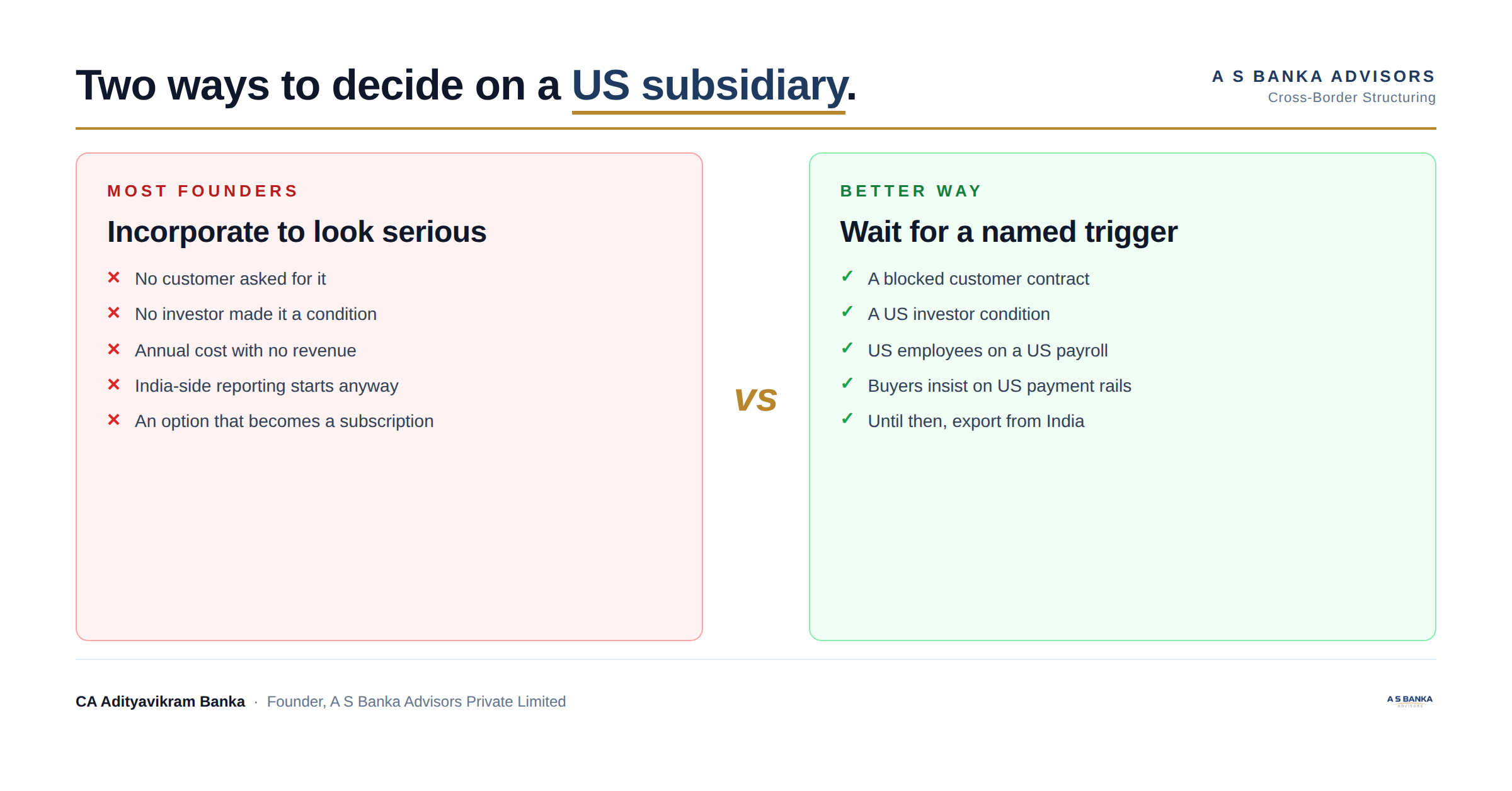
Does Your Indian Startup Need a US Subsidiary? A Founder’s Decision Guide (2026)
Key Takeaways A US subsidiary for an Indian startup is…
How Much Equity Should You Give? ESOP Pool Ranges for Indian Startups
"How much equity should I give my CTO?" It is…