If your business ever bills goods to one address and ships them to another, a quiet change to the E-Way Bill system is about to become unavoidable. GSTN has deferred two new functionalities from 15 June to 1 August 2026, but the word that matters is “deferred,” not “dropped.” From that date, the “Ship-To GSTIN” field stops being optional and becomes mandatory, and a new voluntary E-Way Bill closure facility goes live.
Here is what this actually means for how your goods move, and what you should be doing in July rather than scrambling on 1 August.
What is changing on 1 August 2026
1. Mandatory Ship-To GSTIN. In any Bill-To / Ship-To transaction, where the billed party and the delivery location differ, you must now enter the GSTIN of the actual recipient to whom the goods are being shipped. Where the delivery point is genuinely unregistered, you enter “URP” (Unregistered Person). This touches a lot more than third-party sales: branch transfers, drop-shipments, job-work movements, project-site deliveries and any multi-location supply chain all fall within scope.
2. Voluntary E-Way Bill closure. Today an E-Way Bill stays open until its distance-based validity expires. The new facility lets the supplier, recipient, transporter or driver formally close the EWB the moment delivery is complete. It is optional, but adopting it gives you a cleaner audit trail and fewer mismatch questions later.
What does not change is just as important: the Rs 50,000 consignment threshold, Rule 138 of the CGST Rules 2017, and the distance-based validity structure all stay exactly as they are.
Why this is an operations problem, not a tax problem
The reason GSTN pushed the date back is telling. Industry bodies, GST Suvidha Providers and ERP vendors asked for time to handle system modifications, API integration, testing and master-data clean-up. That tells you where the risk sits. This is not a question of interpreting a new section; it is a question of whether your ship-to master data is accurate and whether your billing software writes the correct GSTIN into the EWB field.
The failure mode is unforgiving. After 1 August, an E-Way Bill generated without a valid Ship-To GSTIN will be rejected at generation. A rejected EWB means the consignment cannot legally move. A stale or incorrect GSTIN sitting in your master data will block the bill even when your team has done everything else right.
What to do in July
- Map every Bill-To / Ship-To flow across your business, including internal branch transfers.
- Clean your ship-to master data and verify each delivery-location GSTIN against the GST portal.
- Brief your GSP and ERP vendor in writing on the mandatory field, and confirm their go-live date.
- Test the API integration end to end after the software update, not on 31 July.
- Update internal SOPs and train whoever generates your E-Way Bills.
- Adopt an E-Way Bill closure policy even though it is voluntary.
- Run dry-run transactions in late July so the first real bill on 1 August is not your first test.
The businesses that treat July as a build-and-test window will not notice 1 August. The ones that wait will find their trucks stationary while someone hunts for a missing GSTIN. The deadline is the easy part to remember; the master-data clean-up is the work.
Download the full carousel PDF for the complete change summary, stakeholder map and pre-1-August checklist.
Need help getting your supply chain and ERP ready for the change? Book a call: https://calendly.com/asbanka-info/30min
Related Posts
Remuneration paid to directors to attract GST – AAR
Companies will have to pay GST under RCM on the…
GST Jurisdiction Migration in 2026: Why a Notice Does Not Lapse When You Move (Circular 255/2026)
If your startup has moved its registered office, opened in…
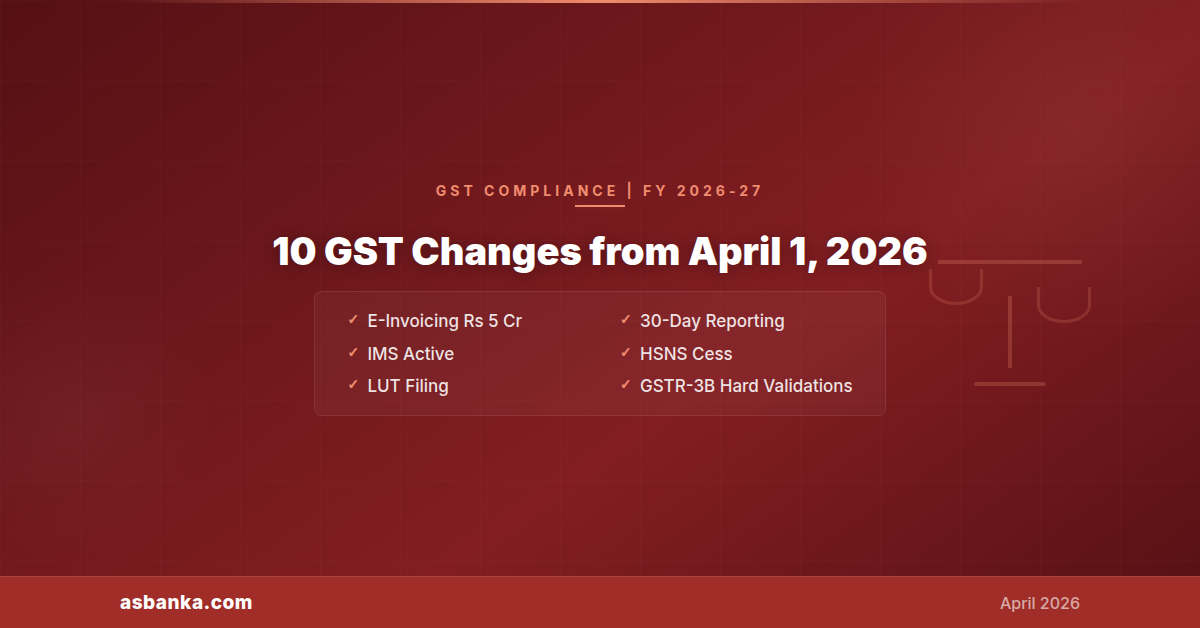
10 GST Changes Every Startup Must Act On Before April 30, 2026
FY 2026-27 started with a quiet revolution in GST compliance.…