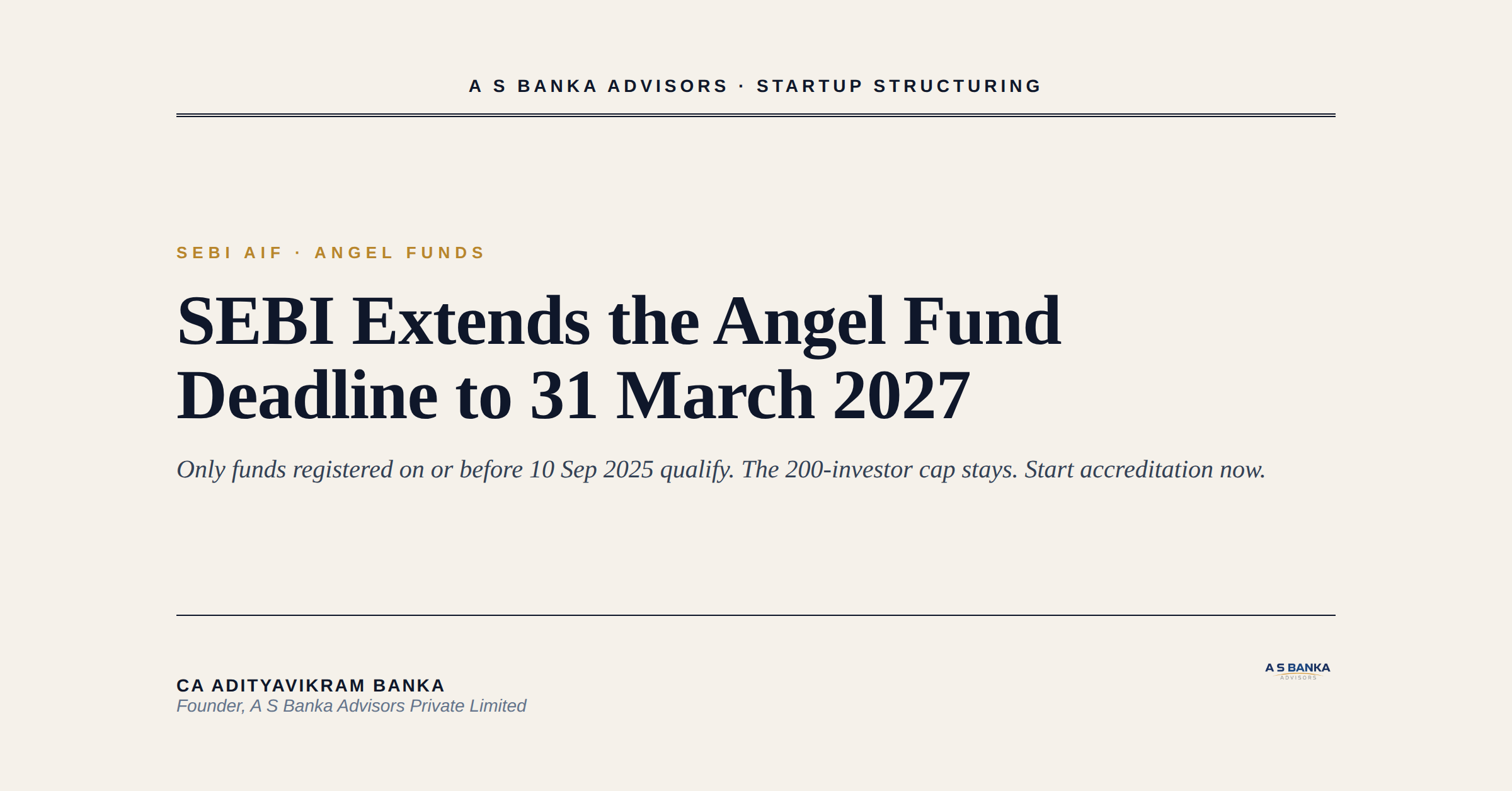
UPDATE (September 10, 2026): The September 8, 2026 deadline described in this post has been superseded. By a circular dated September 7, 2026, SEBI extended the accredited-investor compliance deadline for existing angel funds registered with SEBI on or before September 10, 2025 to March 31, 2027. Funds registered after September 10, 2025 get no relief and remain accredited-investor-only from the outset. The 200 non-accredited investor cap during the transition is unchanged. This extension is in force, effective immediately.
Read our full advisory on the extension here: SEBI Extends the Angel Fund Accredited-Investor Deadline to March 31, 2027. Source note on TaxUpdate.in: SEBI Angel Fund Accredited-Investor Deadline Extended to March 31, 2027. The original September 8 analysis below is retained for reference.
If you manage or advise a SEBI-registered angel fund, this is not a planning memo. It is a countdown. From September 9, 2026, an existing angel fund can accept fresh investment-level contributions only from accredited investors. The transition window that opened when SEBI overhauled the angel fund regime in 2025 closes on September 8, 2026, and the funds that have not done the operational work by then will be offside with the regulator.
The change flows from SEBI Circular SEBI/HO/AFD/AFD-POD-1/P/CIR/2025/128 dated September 10, 2025, issued after the SEBI (Alternative Investment Funds) Regulations were amended in September 2025. Below is the advisory view: not a recital of the circular, but what it actually forces you to change, and what it means if your cap table already carries angel fund money.
The deadline in one line
Paragraph 2.2 of the circular governs funds that were registered on or before the circular date. Such funds must implement the accredited-investor-only mandate on or before September 8, 2026, and during the transition they may not offer an investment opportunity to more than 200 non-accredited investors. Investors already in the fund are grandfathered for the investments they have made, on the terms of the fund’s Private Placement Memorandum. What ends on September 9 is the ability to take a new contribution from a non-accredited investor.
What actually changed in the 2025 framework
The eligibility test grabs the headlines, but the 2025 reset went deeper. Angel funds are now a standalone sub-category under Category I AIF. They are no longer treated as a sub-category of Venture Capital Funds, which changes how you describe the fund in your documentation and to SEBI. Investments are made at fund level without launching a separate scheme, and the earlier requirement to file each term sheet with SEBI has been discontinued, although you must still maintain records of every term sheet and the investors who participated.
The numbers that define compliance
- Rs 25 crore: the cap on total investment by an angel fund in a single investee company, including any follow-on, under paragraph 5.2 of the circular.
- Rs 10 lakh: the rationalised minimum investment per investee under the amended AIF Regulations.
- Five accredited investors: the minimum an angel fund must onboard before it can declare its first close, under Regulation 19D(6).
- 12 months: the window to declare first close after SEBI takes the PPM on record. Existing funds that have not declared a first close must do so by September 8, 2026.
- 200: the ceiling on non-accredited investors to whom an investment opportunity may be offered during the transition.
Who qualifies as an accredited investor
The whole regime now hinges on accreditation, so this is where diligence matters most. At the time of accepting a contribution, the manager must confirm the investor is an accredited investor, either through a valid accreditation certificate or by meeting the deemed-accredited criteria in Regulation 2(1)(ab) of the AIF Regulations. Accreditation is granted by SEBI-recognised agencies against income and net-worth thresholds that are revised from time to time. The practical trap: a certificate that lapsed means the investor is not accredited today. Do not rely on the fact that someone qualified two years ago. Confirm live status before the contribution is drawn.
The compliance checklist for fund managers
With days on the clock, treat this as operations, not strategy. Work through it in order:
- Classify your investor base. Split every investor into accredited (valid certificate or deemed status) and non-accredited, and confirm you never offered an opportunity to more than 200 non-accredited investors.
- Stop the clock at the point of collection. Your drawdown process must block any new-investment contribution from a non-accredited investor on or after September 9, 2026.
- Confirm your first close. If you have not declared it, do so by September 8, 2026 with at least five accredited investors. Miss it, and the circular requires you to refile the PPM and pay the fee.
- Update the PPM. Disclose a defined allocation methodology with no case-to-case discretion. Allocations after October 15, 2025 must follow the disclosed method.
- Re-check limits and records. Keep per-investee exposure within Rs 25 crore, respect the pro-rata and shareholding conditions on follow-on rounds, and maintain the term-sheet records the framework now requires.
What this means if you are a founder
If you raise or have raised from an angel fund, the effect is structural: the pool of individuals who can write a cheque through that fund narrows to accredited investors. That usually means fewer, larger, and better-documented cheques rather than a long tail of small ones. If your cap table already relies on an angel fund, the single most useful thing you can do this week is ask the fund manager to confirm their September 8 readiness in writing. A fund that stumbles on the transition, or that has not declared its first close, can stall a live round at exactly the wrong moment. Regulatory tightening on the fund side and incentives on the company side, such as the startup tax holiday, are two halves of the same journey. Plan for both, and do not let a fund-level compliance gap surprise you mid-raise.
The bottom line
September 8, 2026 is not a soft target. From September 9, an existing angel fund that has not moved to an accredited-investor-only model for new contributions, or that has not declared its first close, is out of line with the circular. Run the checklist this week, verify every investor’s accreditation status against the current SEBI thresholds, and get your first close and PPM in order before the window shuts.
Download the full SEBI Angel Fund 2026 deadline carousel (PDF) for a slide-by-slide summary you can share with your fund manager or investment committee.
Unsure whether your angel fund or your cap table is ready for September 8? Get expert guidance on mapping your investor base, first-close status and documentation against the revised SEBI framework. Book a quick call: https://calendly.com/asbanka-info/30min. CA Adityavikram Banka, Founder, A S Banka Advisors Private Limited.
This post is for general information based on SEBI Circular SEBI/HO/AFD/AFD-POD-1/P/CIR/2025/128 dated September 10, 2025 and the SEBI (AIF) Regulations as amended. Accreditation thresholds and SEBI requirements are updated from time to time. Confirm the current position on the SEBI website and with a SEBI-recognised accreditation agency before acting. This is not legal or investment advice.
Related Posts
The Due Diligence Data Room Checklist for Series A
"Can you share your data room?" This is the first…
SEBI Extends the Angel Fund Accredited-Investor Deadline to March 31, 2027: A Runway, Not a Reversal (2026)
If you manage or advise a SEBI-registered angel fund, the…

The Startup Cap Table Guide: From Founding to Series A
Your cap table is the single most important financial document…