
Key Takeaways
- FEMA penalties can be up to 3x the contravention amount for ongoing violations.
- RBI’s compounding facility lets you self-report and settle penalties before enforcement action.
- The compounding fee depends on the contravention amount, how long it was outstanding, and the nature of the violation.
- Most startup FEMA violations are unintentional (missed filings, wrong remittance route) and can be resolved through compounding.
- Prevention costs a fraction of the penalty. A FEMA compliance calendar eliminates most common violations.
Why FEMA Penalties Are a Growing Risk for Indian Startups
More Indian startups are expanding globally than ever before. US subsidiaries, Singapore holding companies, UAE entities for market access. Each of these structures triggers FEMA (Foreign Exchange Management Act) obligations that most founders don’t know about.
The problem: FEMA compliance is not a one-time event. It’s an ongoing obligation. And the penalties for non-compliance are not nominal warning letters. They’re calculated as a multiple of the contravention amount.
I’ve helped founders unwind FEMA violations that started with a simple wire transfer to their US subsidiary. By the time they discovered the issue, the penalty exposure had compounded to several multiples of the original transaction.
This guide explains how FEMA penalties work, what the compounding process looks like, and what you should do if you’ve missed a filing.
How FEMA Penalties Are Calculated
FEMA penalties fall into two categories:
Contravention Penalties (Section 13 of FEMA)
For ongoing violations where the contravention continues, the penalty can be up to 3 times the amount involved. For one-time violations, the penalty can be up to 3x the amount or Rs 2 Lakh, whichever is higher.
Compounding Fees (Section 15 of FEMA)
RBI has the power to compound (settle) contraventions. The compounding amount is typically 5% to 150% of the contravention amount, depending on the nature, duration, and severity of the violation.
The 5 Most Common FEMA Violations by Indian Startups
- Missing the Annual Performance Report (APR) for overseas subsidiaries (due by December 31 each year)
- Not filing Form ODI within 30 days of investing in a foreign entity
- Using LRS instead of ODI route for business investment (sending money through personal remittance route instead of the business investment route)
- Not reporting receipt of foreign investment (Form FC-GPR) within 30 days
- Missing Form FLA (Foreign Liabilities and Assets) filing, due by July 15 each year
The Compounding Process: Step by Step
RBI’s compounding facility is essentially a self-reporting mechanism. Instead of waiting for RBI to discover the violation and initiate proceedings, you can resolve it proactively:
- Identify the contravention: What filing was missed, when, and what amount was involved
- File a compounding application with the relevant RBI Regional Office
- RBI reviews the application and determines the compounding amount
- Pay the compounding fee
- RBI issues a compounding order, closing the matter
The advantage: compounding is significantly cheaper than adjudication. If RBI initiates enforcement action on its own, the penalties are higher, and the process includes formal proceedings.
Factors That Determine the Compounding Amount
- The nature of the contravention (procedural vs. substantive)
- The amount involved
- The period of contravention (how long the violation was outstanding)
- Whether the contravention was voluntarily disclosed or discovered by RBI
- Whether there was any financial gain from the contravention
What to Do If You’ve Missed a FEMA Filing
- Don’t panic, but don’t ignore it. FEMA violations don’t go away. They accumulate over time. The sooner you address them, the lower the penalty.
- Calculate your exposure. Use a FEMA Penalty Calculator to estimate what you might owe. The calculation depends on the amount involved and the period of non-compliance.
- Engage a FEMA-qualified CA or lawyer. Compounding applications require specific documentation and must be filed with the correct RBI Regional Office.
- File the overdue returns first. Complete the missed filings (APR, Form FC-GPR, Form FLA) even if they’re late. Late filing with compounding is always better than non-filing.
- Prevent future violations. Set up a FEMA compliance calendar with all filing deadlines. Most violations are simple oversights that a calendar would prevent.
Prevention: The FEMA Compliance Calendar
The most effective way to avoid FEMA penalties is a compliance calendar that tracks every filing deadline:
| Filing | Deadline | Who Must File |
|---|---|---|
| Form FLA | July 15 each year | All entities with foreign investment or overseas subsidiaries |
| APR (Annual Performance Report) | December 31 each year | Every entity with an overseas subsidiary/JV |
| Form FC-GPR | Within 30 days of receiving foreign investment | Indian company receiving FDI |
| Form ODI | Within 30 days of making an overseas investment | Indian entity investing abroad |
| Form ADV | Within 30 days | For acquisition of overseas entities |
For a complete, downloadable checklist with all deadlines and forms, see our FEMA Compliance Checklist.
For more on structuring your foreign subsidiary correctly from the start, read our guide on how to set up a US subsidiary without getting FEMA wrong.
Frequently Asked Questions
What is the maximum FEMA penalty for Indian startups?
Under Section 13 of FEMA, the penalty can be up to 3 times the amount involved in the contravention. For continuing violations, additional daily penalties may apply until the contravention is rectified.
Can FEMA penalties be compounded (settled) with RBI?
Yes. RBI has the power to compound FEMA contraventions under Section 15. The compounding fee is typically lower than the penalty that would be imposed through formal adjudication proceedings.
What is the most common FEMA violation by Indian startups?
Missing the Annual Performance Report (APR) filing for overseas subsidiaries is the most common violation. Many founders don’t know this filing exists until RBI flags it when they apply to send more money abroad.
How long does the FEMA compounding process take?
The process typically takes 3 to 6 months from application to order, depending on the complexity of the contravention and the RBI Regional Office’s workload.
Can I avoid FEMA penalties by filing late returns?
Late filing alone does not eliminate the penalty exposure. You should file the overdue returns AND apply for compounding to formally resolve the contravention. However, late filing demonstrates good faith and typically results in lower compounding amounts.
Disclaimer: This article is for educational purposes only and does not constitute legal or regulatory advice. FEMA regulations are complex and involve multiple variables specific to your company’s structure, investment amount, and jurisdiction. Consult a qualified FEMA advisor before taking any action. Contact A S Banka Advisors Private Limited for expert guidance on FEMA compliance and compounding.
Related Posts
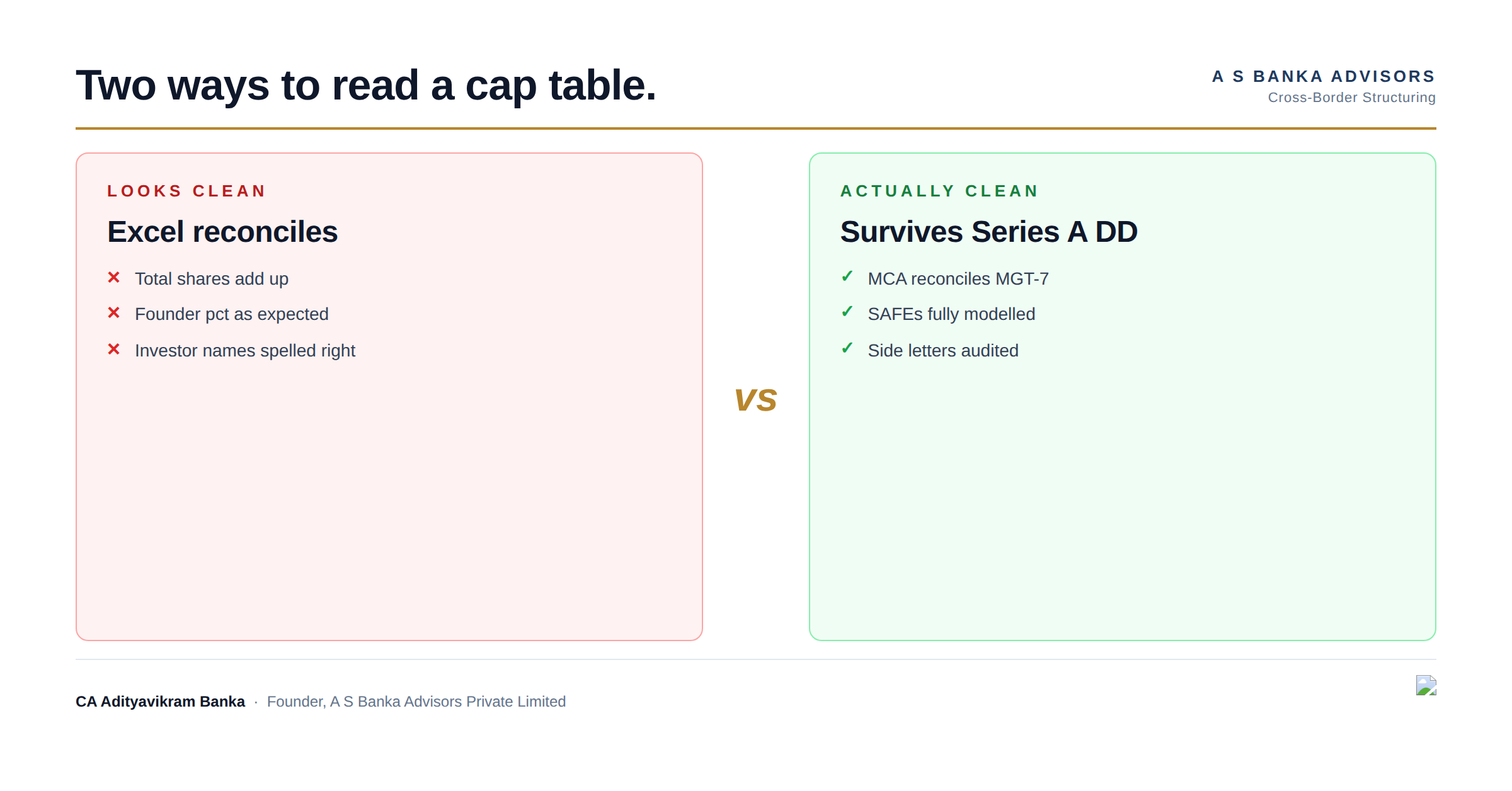
Why Your Cap Table Looks Clean But Isn’t
Key Takeaways A cap table that reconciles in Excel is…
Due Diligence Data Room for Startup
Due Diligence Data Room for Startup. How to Prepare for…

What is FDI? Why it Matters for Startups & MSMEs
? Foreign Direct Investment (FDI) is a critical growth enabler…