You want to retain your best people. You’ve heard about ESOPs. Maybe someone mentioned Phantom Stock. Your CA says “just do ESOPs” because that’s what everyone does.
Here’s the problem: “what everyone does” is exactly how founders end up with bloated cap tables, tax-trapped employees, and FEMA complications they discover 2 years too late.
This guide breaks down both structures with real numbers, real compliance implications, and a decision framework so you can pick the right one for your specific stage and team.
What Is an ESOP?
An Employee Stock Option Plan (ESOP) gives employees the right to purchase actual shares of the company at a predetermined price (the “exercise price”) after a vesting period.
Key characteristics:
- Legal basis: Governed by Section 62(1)(b) of the Companies Act, 2013 and Rule 12 of the Companies (Share Capital and Debentures) Rules, 2014
- Board + shareholder approval required before implementation
- Shares are real: Once exercised, the employee becomes a shareholder with voting rights
- Cap table impact: Every exercised option adds a new row to your cap table
- Minimum vesting period: 1 year from the date of grant (as per Companies Act)
- Valuation requirement: Exercise price is set by the company under its accounting policies; the tax value at exercise needs a SEBI-registered Category I merchant banker’s valuation
The compliance load:
- Special resolution by shareholders
- Board resolution for each grant
- Form PAS-3 filed with ROC for every allotment
- Stamp duty on share certificates
- Annual disclosures in the Board’s Report
For a 20-person startup granting options to 8 employees, that’s a meaningful amount of paperwork every year.
What Is Phantom Stock?
A Phantom Stock plan (also called Stock Appreciation Rights or SARs) gives employees a cash payout tied to the company’s share value, without issuing actual shares.
Key characteristics:
- Legal basis: Contractual arrangement between employer and employee. No Companies Act approval required.
- No shares issued: The employee never becomes a shareholder
- Zero cap table impact: Your ownership structure stays exactly the same
- No exercise price: Employee pays nothing upfront. They receive a cash payout equal to the appreciation in value at the trigger event
- Payroll treatment: The payout is treated as a bonus or incentive, deducted as an employee cost, and taxed as salary income
- No FEMA implications: Critical for startups with cross-border teams. Since no shares change hands, there are zero FEMA reporting obligations
The Side-by-Side Comparison
| Parameter | ESOP | Phantom Stock |
|---|---|---|
| What employee gets | Actual shares (after exercise) | Cash payout linked to share value |
| Exercise price | Yes, employee pays to exercise | None. Zero upfront cost. |
| Cap table impact | Yes, new shareholder added | None |
| Voting rights | Yes, after exercise | None |
| Companies Act compliance | Heavy (special resolution, PAS-3, valuer) | Minimal (board resolution, contract) |
| Cost to company | No cash outflow (employee pays exercise price) | Cash outflow at payout event |
| Tax timing for employee | At exercise (perquisite tax on paper profit) | At payout (taxed as salary income) |
| FEMA implications | Yes, triggers FEMA reporting for non-residents | None |
| Dilution | Yes, dilutes existing shareholders | None |
| Setup cost | Rs 1-3L (valuer, legal, compliance) | Rs 50K-1L (legal drafting) |
The Cash Flow Reality Check
Let’s run the numbers on a real scenario.
Setup: Your CTO receives 1,000 units. Current share value: Rs 100. Company grows. Share value at vesting: Rs 500.
Scenario A: ESOP
- CTO exercises options: pays Rs 1,00,000 (1,000 x Rs 100 exercise price)
- Perquisite value at exercise: Rs 4,00,000 (Rs 500 – Rs 100 = Rs 400 x 1,000)
- Tax on perquisite (at 30% slab): Rs 1,20,000
- Total cash outflow for the CTO: Rs 2,20,000
- CTO now holds shares worth Rs 5,00,000 on paper. But they can’t sell them.
- Net position: CTO is Rs 2,20,000 cash negative for shares they can’t liquidate.
Scenario B: Phantom Stock
- CTO pays nothing during the vesting period
- At trigger event: CTO receives Rs 4,00,000 cash payout
- Tax on payout (as salary, 30% slab): Rs 1,20,000
- Net cash received: Rs 2,80,000
- Zero exercise cost. Zero liquidity risk. Cash in hand.
The difference: Under ESOP, the CTO is Rs 2,20,000 out of pocket with illiquid shares. Under Phantom Stock, the CTO receives Rs 2,80,000 in cash. That’s a Rs 5,00,000 swing in real-world outcomes.
The Cross-Border Angle: Why Phantom Stock Wins for Global Teams
If your startup has employees outside India, FEMA regulations add complexity to ESOPs that most CAs underestimate.
ESOP to a non-resident employee: Allotment triggers FEMA pricing guidelines, RBI reporting, and potentially US 409A valuation requirements.
Phantom Stock to a non-resident employee: No shares issued. It’s a cash bonus. Zero FEMA reporting. Zero cross-border complications.
For startups with remote teams across India, US, and UAE, Phantom Stock eliminates an entire category of compliance risk.
When to Use Which: The Decision Framework
Choose ESOP when:
- You’re Series A+ with a clear path to liquidity (IPO or acquisition within 3-5 years)
- Your employees specifically want ownership and voting rights
- You have the compliance infrastructure already in place
- Your team is 100% India-based
Choose Phantom Stock when:
- You’re pre-seed to seed stage and want to retain talent without dilution
- Your team includes non-resident employees (US, UAE, Singapore)
- You want to avoid cap table bloat before a fundraise
- You’re bootstrapped where dilution directly reduces founder control
The hybrid approach: Many of our advisory clients use both. ESOPs for the founding team and C-suite, and Phantom Stock for senior managers and cross-border employees.
What to Do Next
If you’re about to hire a senior leader and planning to offer equity, get the structure right before you make the offer.
Download our free 1-pager: Phantom Stock vs ESOP – The Quick Comparison
Or book a quick strategy call to design a custom retention structure for your specific team, stage, and cap table:
Disclaimer: This article is for educational purposes and does not constitute legal or tax advice. Consult a qualified professional for advice specific to your situation.
Related Posts
FEMA Year-End Compliance: What APR and FLA Filings Mean for Your Startup
March 31 is four days away. If your startup has…
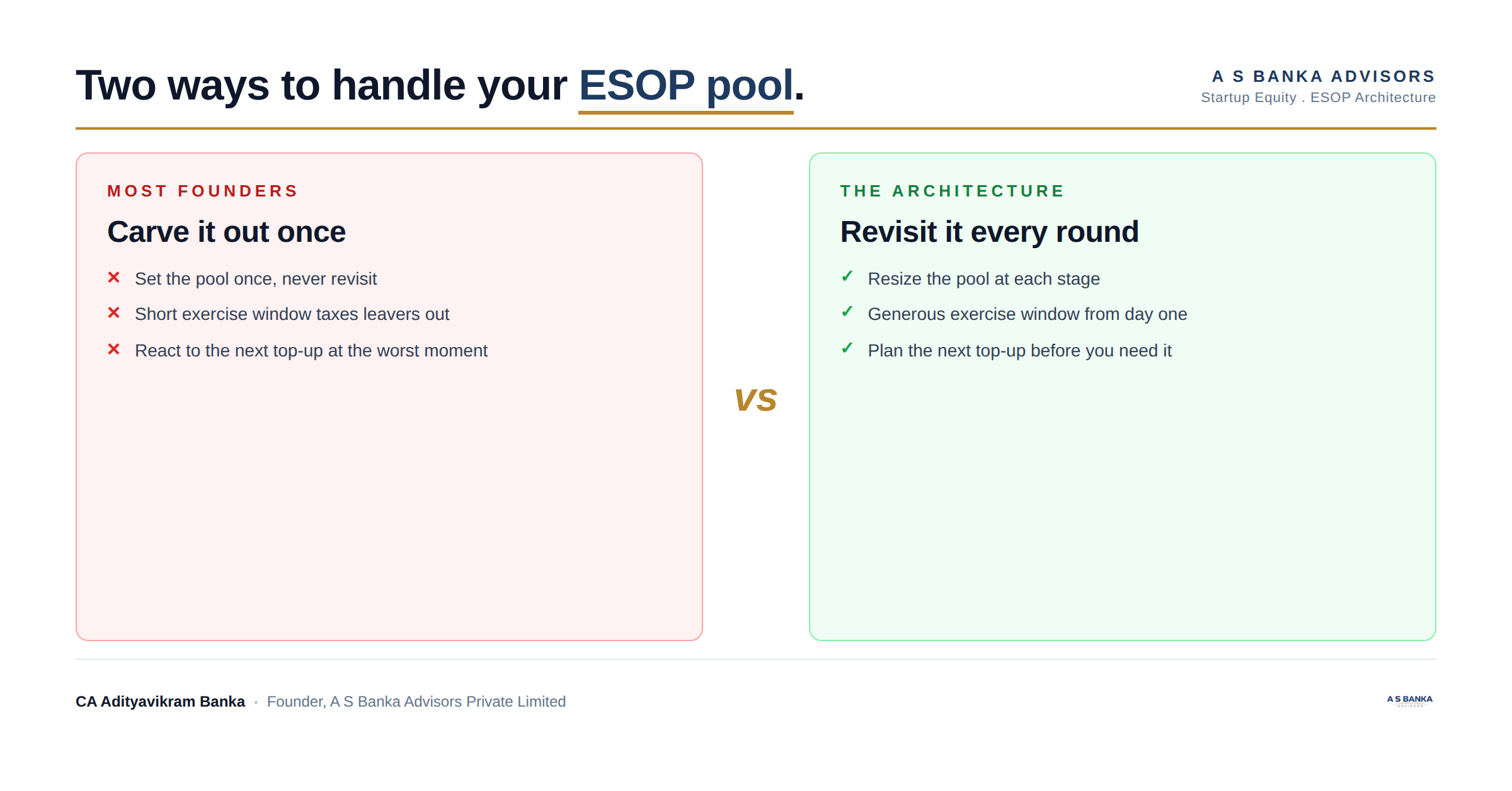
ESOP Architecture for Indian Startups: How to Design a Pool That Survives Every Funding Round (2026)
Most founders treat their ESOP as a single decision. They…
SEBI’s New AIF Reporting Framework: What Fund Managers and Startup Founders Should Know
A Fundamental Shift in AIF Compliance If you are involved…