
Key Takeaways
- When your Indian company deals with a company abroad that it owns, that owns it, or that shares its owners, the Income-tax Act requires the income from those deals to be worked out at an arm’s length price: the price two unrelated companies would agree.
- There is no minimum value for the transfer-pricing report. Any such transaction in the year means your company must get a report from an accountant and file it one month before its income-tax return is due.
- The detailed documentation the rules list is not required where the year’s total of such transactions, as recorded in the books, does not exceed Rs 1 crore. Your company must still be able to show that its pricing was at arm’s length.
- For FY 2025-26 the report is Form 3CEB, due 31 October 2026. From tax year 2026-27 it is Form No. 48 under the Income-tax Rules 2026, due one month before the 30 November return date.
- Not keeping the documents, or leaving a transaction out of the report, can cost a penalty of 2% of the value of each transaction.
You flipped to a US parent and your Indian company now builds the product for it. Or you set up a sales company in Dubai, Singapore or the UK and your Indian team does the work behind it. Either way, from the first invoice, your Indian company is dealing with a company you also control, and Indian tax law has a name for that: transfer pricing. This guide to transfer pricing for startups in India covers who counts as related, what has to be priced, what you have to document and file, the dates for 2026, and what a miss costs.
Who counts as your “associated enterprise”?
The Income-tax Act calls a related company an associated enterprise. The tests are wide. A foreign company is associated with your Indian company if, among other things:
- one company holds shares carrying 26% or more of the voting power in the other, or the same person holds 26% or more in both;
- one company appoints more than half of the other’s board, or one or more of its executive directors, or the same person does so for both;
- one company has lent the other an amount equal to 51% or more of the book value of its total assets; or
- one company guarantees 10% or more of the other’s total borrowings.
A flipped startup and its US parent meet the first test. So does an Indian company and the foreign subsidiary it owns.
What counts as an international transaction?
Any transaction between two associated enterprises where at least one of them is a non-resident. The Act’s list reads like a startup’s ordinary month:
- Services: software development, design, technical support, marketing, administration, consulting.
- Intangibles: the use or transfer of code, copyrights, brand, know-how or customer lists.
- Money: loans, borrowing, guarantees, advances, deferred payments and unpaid invoices between the two companies.
- Shared costs: an agreement to split a cost that benefits both, such as a salary, a tool or an office.
- Restructuring: a business restructuring or reorganisation between the two companies.
Note the money line. An invoice your foreign company has not paid is itself listed as a transaction to be priced, not just the sale behind it.
What does “arm’s length price” mean for a startup?
The arm’s length price is the price that would apply between companies that are not related, in uncontrolled conditions. The Act sets out six ways to find it: the comparable uncontrolled price method, the resale price method, the cost plus method, the profit split method, the transactional net margin method, and any other method the Central Board of Direct Taxes prescribes. The most appropriate one is chosen by looking at the nature of the transaction and the functions each company performs.
The rule works in one direction. The Act says it does not apply where the result would reduce the income taxable in India or increase a loss. So an Indian company that charges its foreign parent too little can see its income raised; one that charges too much cannot use the rule to bring it down.
Where transfer pricing shows up in a startup
You flipped, and the Indian company builds for the parent
The Indian company provides development and support services to the foreign parent. What it charges for those services, and the profit it keeps, has to be at arm’s length.
You own a sales company abroad
The foreign company sells to customers and the Indian company delivers, bills the foreign company, or pays it a commission. Each of those flows is an international transaction.
One team, two companies
Founders and staff work for both companies, and one company pays a salary, a software bill or rent that benefits both. Where the two companies agree to share such a cost, the Act requires the share each one bears to be worked out at arm’s length too.
Is there a minimum before transfer pricing applies?
For the pricing and the report, no. The Rs 1 crore figure in the rules is a line for documentation only.
| Duty | Minimum value | What it involves |
|---|---|---|
| Price each transaction at arm’s length | None | Every international transaction in the year |
| Accountant’s report | None | Filed by every company that had such a transaction in the year, one month before its return is due |
| Detailed documentation the rules list | Required where the year’s total, as recorded in the books, exceeds Rs 1 crore | Ownership structure, the nature and terms (including prices) of each transaction, functions, risks and assets, the method chosen and why, and the working. At or below Rs 1 crore, you must still be able to show your pricing was at arm’s length. |
| Producing documents when asked | None | Under the Income-tax Act 2025, within ten days of a notice, extendable by up to thirty more days on application |
When is the transfer pricing report due in 2026 and 2027?
The report is due one month before the company’s return. For a company that has to file this report, the return is due on 30 November.
- FY 2025-26 (Income-tax Act 1961): the report is Form 3CEB, due 31 October 2026. The return is due 30 November 2026. CBDT’s circular of 28 September 2026 moved the return date for other companies to 21 November 2026; it does not cover companies that have to file this report. Our earlier note on why FY 2025-26 Form 3CEB still files under the 1961 Act covers the transition.
- Tax year 2026-27 onward (Income-tax Act 2025): the report is Form No. 48 under the Income-tax Rules 2026, due one month before the 30 November return date, so 31 October 2027 for the year that started on 1 April 2026.
What does it cost to get it wrong?
- Documents not kept, a transaction not reported, or incorrect information: a penalty of 2% of the value of each transaction concerned, under both the 1961 Act and the 2025 Act.
- Report not filed (FY 2025-26): a penalty of Rs 1,00,000 under the 1961 Act.
- Report filed late (tax year 2026-27 onward): a fee of Rs 50,000 for a delay of up to one month and Rs 1,00,000 after that, under the 2025 Act.
- The price itself: where the documents were not kept, the Act allows the tax officer to work out the arm’s length price himself, on the material he has.
The foreign-exchange side: getting paid by your own company
Billing a company you own abroad is still an export of services. Under RBI’s export regulations in force from 1 October 2026, the money for services has to be realised and brought into India within nine months from the date of the invoice. RBI’s regulations also let your bank allow a set-off of what the foreign company owes you against what you owe it, including with its group companies, within that period. The set-off goes through the bank; it is not something the two companies can simply agree between themselves.
Both rules meet on the unpaid invoice. An invoice that sits unpaid is a foreign-exchange problem after nine months and, under the Income-tax Act, a transaction to be priced in its own right.
A founder’s checklist
- List every company abroad that is associated with yours under the tests above.
- List every flow with each of them this year: services, use of code or brand, loans, guarantees, unpaid invoices, shared costs.
- Put the terms and prices of each in writing. The documents the rules list start with the nature and terms, including prices, of each transaction.
- Choose the pricing method and record why it is the most appropriate one.
- Add up the year’s value as recorded in your books. Above Rs 1 crore, keep the full documentation the rules list.
- Book the accountant’s report now: Form 3CEB by 31 October 2026 for FY 2025-26.
- Invoice the foreign company on time, collect within nine months, and route any set-off through your bank.
Our view: set the price before the first invoice goes out, not when the report falls due. A price fixed in advance and written into an agreement is far easier to defend than one reconstructed at year end. If the amounts are large or the pricing is complex, an advance pricing agreement can settle the method with the tax department in advance; our note on when to file an APA application explains the timing. And if you are still deciding whether you need a company abroad at all, start with our US subsidiary decision guide.
Frequently asked questions
Does transfer pricing apply to a loss-making startup?
Yes. The Act has no exemption for loss-making companies. The one limit is that it is never applied to reduce income taxable in India or to increase a loss.
Is there a minimum transaction value for the transfer pricing report?
No. Every person who entered into an international transaction during the year has to obtain and file the accountant’s report. The Rs 1 crore figure applies only to the detailed documentation.
Who is an associated enterprise for transfer pricing?
Among other tests, a company that holds 26% or more of the voting power in the other, one that appoints more than half of its board, one that has lent it 51% or more of the book value of its total assets, or one that guarantees 10% or more of its borrowings.
When is Form 3CEB due for FY 2025-26?
31 October 2026, one month before the 30 November 2026 return due date for companies that have to file it.
The bottom line
Owning a company abroad turns your Indian company’s dealings with it into transfer pricing from the first invoice. There is no minimum for the report, the documentation line is Rs 1 crore, and for FY 2025-26 the date is 31 October 2026. Priced and written down in advance, it is routine. Reconstructed at year end, it is much harder to defend.
Your Indian company deals with a company abroad that you own, and you want the pricing and the paperwork in place before the report is due? You can book a quick call with A S Banka Advisors Private Limited.
Sources: Income-tax Act 2025, as amended by the Finance Act 2026 (incometaxindia.gov.in). Income-tax Act 1961, as amended by the Finance Act 2026 (incometaxindia.gov.in). Income-tax Rules 2026, Notification No. 22/2026, consolidated as on 22 September 2026 (incometaxindia.gov.in). Income-tax Rules 1962, consolidated as on 1 April 2026 (incometaxindia.gov.in). CBDT Circular No. 07/2026 dated 28 September 2026 (incometaxindia.gov.in). Reserve Bank of India, Foreign Exchange Management (Export and Import of Goods and Services) Regulations, 2026, Notification No. FEMA 23(R)/2026-RB dated 13 January 2026, as amended by Notification No. FEMA 23(R)/(1)/2026-RB dated 22 September 2026 (rbi.org.in).
Disclaimer: This article is general information for founders and is not legal, tax or investment advice. It states the position as on the date of publication; confirm the current position for your company and each transaction before acting.
Related Posts
ICDS Under the Income-tax Act 2025: The Section Numbers Changed, Your Obligations Did Not (FY 2026-27)
If you run a company that files a tax audit,…
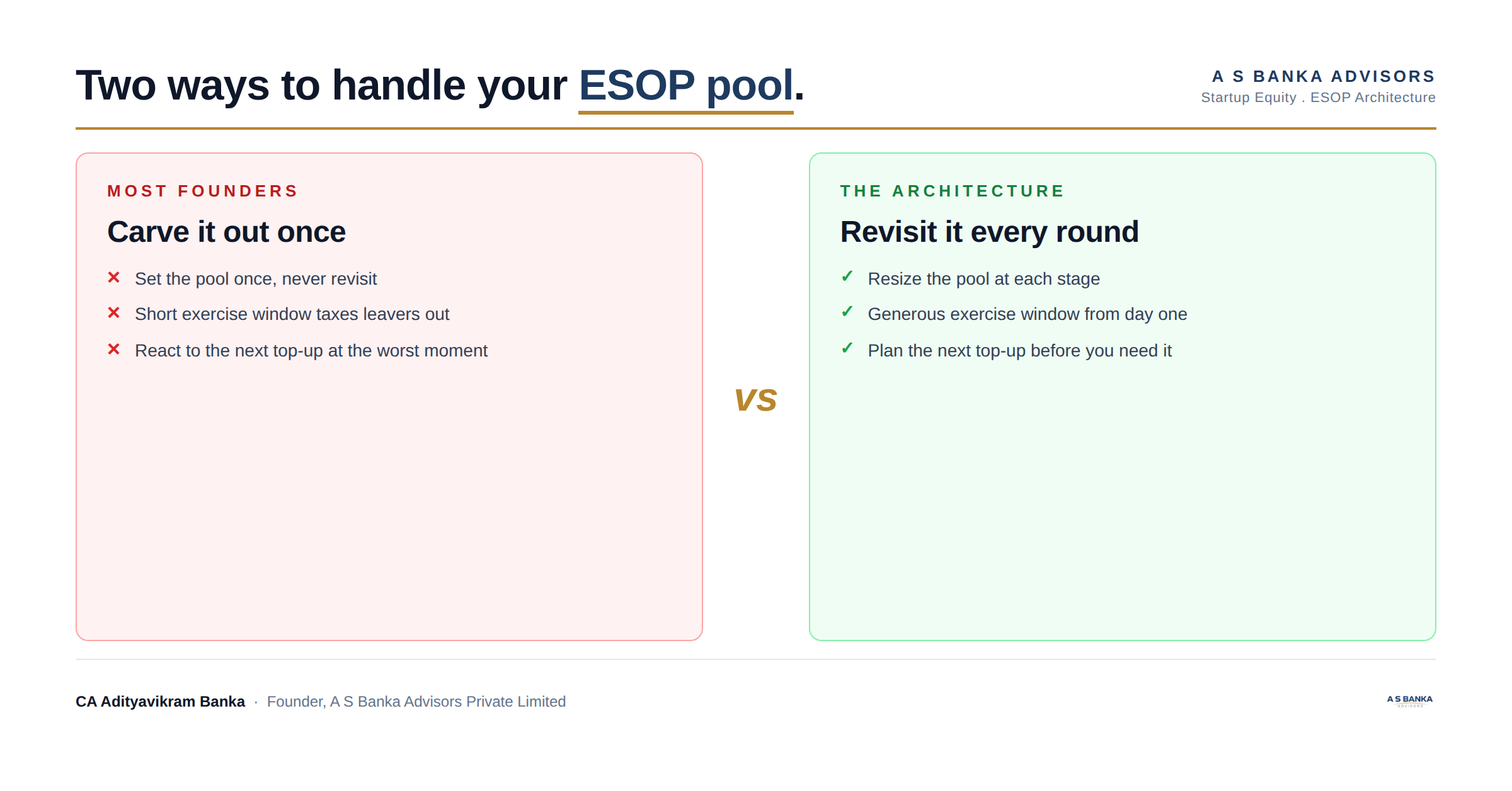
ESOP Architecture for Indian Startups: How to Design a Pool That Survives Every Funding Round (2026)
Most founders treat their ESOP as a single decision. They…

FCRA Registration by Charitable Organisation for Foreign Donation
FCRA Registration for NGOs The Ministry of Home Affairs grants…