
If your Indian entity has any cross-border related-party transaction, this provision can convert a paper-only transfer pricing adjustment into a real cash repatriation deadline, and a daily-accruing tax liability. Section 92CE of the Income-tax Act, 2025 is one of the highest-stakes provisions for founders running global structures, and most teams discover it only when an assessment is already final.
What Section 92CE Actually Does
A primary transfer pricing adjustment under Section 92C raises your taxable income, but the cash never moves between you and your overseas associated enterprise (AE). Section 92CE forces a separate cash repatriation. It treats the unmoved excess as a deemed loan from your Indian entity to the AE, and accrues imputed interest until the cash actually returns. The Income-tax Act, 2025 retains this mechanism unchanged for AY 2026-27 onwards, with the saving clause in Section 532 preserving liability for older years.
When It Triggers, And When It Does Not
Section 92CE applies whenever a primary transfer pricing adjustment in any single previous year exceeds Rs 1 crore, and the underlying year is AY 2017-18 or later. The five trigger paths are independent, and any one of them is enough: (i) suo-moto adjustment in your return, (ii) AO order accepted by you, (iii) APA-determined adjustment under Section 92CC, (iv) safe harbour adjustment under Section 92CB, and (v) MAP resolution under Sections 90/90A. If your TP adjustment is below Rs 1 crore in a year, or relates to AY 2016-17 or earlier, Section 92CE does not apply.
The 90-Day Window That Most Teams Miss
Once Section 92CE is triggered, your AE has 90 days to repatriate the excess cash to India. Rule 10CB gives different anchor dates depending on the source of the adjustment: due date u/s 139(1) for return-based adjustments, AO order date for accepted assessments, APA date for advance agreements, the year-end filing date for safe harbour cases, and the MAP-give-effect date for treaty resolutions. If the cash does not arrive on day 91, deemed interest starts compounding daily on the unrepatriated balance.
The Real Cost: Phantom Interest That Never Stops
Deemed interest accrues at SBI 1-year MCLR plus 325 basis points for INR-denominated transactions (approximately 12.30 percent for FY 2026-27), or at 6-month SOFR/EURIBOR plus 300 basis points for foreign-currency transactions. The rate is fixed annually as of 1 April. The amount lands as taxable income each year, and must be disclosed in Form 3CD Clause 30B and Form 3CEB Part B Clause 16. Skipping the disclosure exposes you to Section 271AAB penalty proceedings of 1 to 2 percent of the undisclosed amount, plus general concealment penalties under Section 270A.
Run a simple model on a Rs 5 crore unrepatriated balance at 12.30 percent for 5 years: roughly Rs 3.07 crore of additional taxable income over the period, and Rs 76.7 lakh of pure phantom-interest tax at the 25 percent corporate rate, paid on cash that never reached India. This is the silent cost of doing nothing.
The 18 Percent Settlement Escape Hatch
Section 92CE(2A), inserted by Finance Act (No. 2), 2019, lets you settle the secondary adjustment with a one-time additional tax of 18 percent on the unrepatriated principal, plus 12 percent surcharge on that tax, plus 4 percent health and education cess. The effective rate is 20.9664 percent of the unrepatriated amount. Three things to know: (i) it stops further deemed interest from the settlement date, (ii) you no longer have to repatriate, and (iii) it is irreversible. No tax credit is available against the 18 percent, and a later remittance does not unwind the settlement. The option exists primarily for AEs in no-banking-corridor jurisdictions, AEs in insolvency, and AEs owned by sovereign-wealth funds.
The decision rule is simple. Model the IRR of continued daily interest accrual versus the 20.9664 percent one-time payment. The 18 percent settlement typically becomes economically attractive when imputed interest exceeds 4 to 5 years of accrual at MCLR plus 325 bps.
What Your Team Should Do Before September 30, 2026
AY 2026-27 is the first audit year under the Income-tax Act, 2025. Three concrete actions every Indian entity with international related-party transactions should complete before the tax audit window closes:
- Build a Section 92CE register. Pull every TP adjustment from FY 2017-18 onwards, by AY, by AE, by transaction type. Apply the Rs 1 crore filter and the AY 2017-18 cutoff. Document repatriation status with FIRC evidence and AD Bank confirmation for each remaining adjustment.
- Re-do your interest math. Compute deemed interest from day 91 of each trigger date through 31 March 2026, daily basis, at the correct currency-specific rate. Add the deemed interest to the relevant year’s total income and amend Form 3CD Clause 30B if needed.
- Run the 18 percent settlement IRR. For any unrepatriated balance more than 4 years old, model the settlement option in writing and present it to the board. If the AE structurally cannot remit (banking corridor, insolvency, sovereign-wealth ownership), settle the matter once and stop the daily interest bleed.
Common Mistakes That Cost Crores
Five recurring errors we see in tax audit reviews: (1) ignoring closed assessment years, even though Section 92CE applies on a per-year basis from the order date, (2) computing deemed interest on the full primary adjustment amount despite partial repatriation, (3) confusing the 18 percent additional tax with the regular Section 115BAA corporate tax rate, (4) skipping Form 3CD Clause 30B disclosure entirely, and (5) treating a MAP resolution as full closure when Section 92CE(1)(v) explicitly preserves the secondary adjustment liability.
Carousel: 9-Slide Deep Dive
Download the complete 9-slide carousel walking through each trigger, the Rule 10CB anchor dates, the deemed interest math, the 18 percent settlement decision tree, and the 10-step compliance checklist for AY 2026-27.
Download the full Section 92CE carousel PDF
Need Help Structuring This?
If your Indian entity has unrepatriated TP adjustments, or if your AE structure makes repatriation impractical, the 18 percent settlement decision is a board-level call that should be modelled, documented, and executed before the next audit cycle. We help startups, family-business groups, and inbound MNCs structure the secondary adjustment treatment, prepare board approvals, and coordinate the AD Bank inward remittance flow.
Schedule a Strategy Session with A S Banka Advisors Private Limited: https://calendly.com/asbanka-info/30min
Related Posts
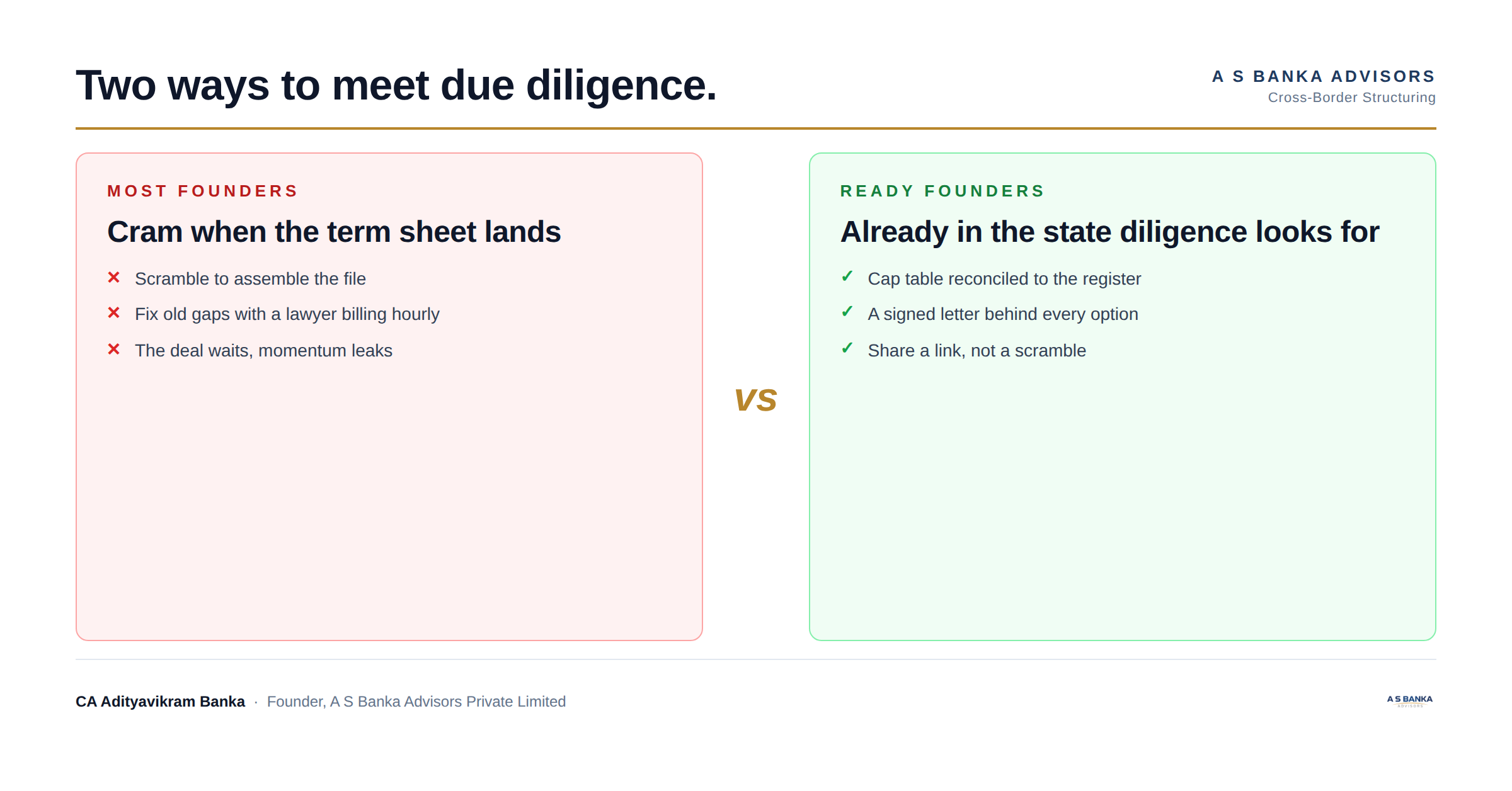
The Startup Due Diligence Checklist Indian Founders Should Run Before Investors Do
Key Takeaways Due diligence is a state, not an event.…
ICDS Under the Income-tax Act 2025: The Section Numbers Changed, Your Obligations Did Not (FY 2026-27)
If you run a company that files a tax audit,…

Transit rent paid by the developer is not a revenue receipt and so not taxable: Bombay HC
Transit rent paid by the developer is not a revenue…