The Ministry of Corporate Affairs just opened a door that many defaulting companies did not expect. If your startup has a dormant Pvt Ltd entity sitting with unfiled annual returns, or if you are a CA with clients carrying years of ROC compliance backlog, this is the most cost-effective compliance window you will see in 2026.
What is CCFS-2026?
The Companies Compliance Facilitation Scheme, 2026 (CCFS-2026), launched through General Circular No. 01/2026 dated February 24, 2026, is a one-time amnesty under Sections 460 and 403 of the Companies Act, 2013. The scheme operates from April 15, 2026 to July 15, 2026, giving companies exactly 90 days to resolve their ROC filing defaults at heavily reduced costs.
Three Pathways: File, Freeze, or Close
What makes CCFS-2026 particularly useful is that it does not assume every defaulting company wants to become compliant. It acknowledges three different intentions:
Pathway 1: Clear Your Filing Backlog (90% Fee Waiver). If your company intends to continue operating, you can file all pending annual returns (MGT-7, MGT-7A), financial statements (AOC-4, AOC-4 CFS, AOC-4 NBFC), and auditor appointment forms (ADT-1) at just 10% of accumulated penalty fees. A company facing Rs 1,00,000 in additional fees pays only Rs 10,000. This also covers foreign company filings (FC-3, FC-4) and legacy forms under the Companies Act, 1956.
Pathway 2: Go Dormant (50% Fee Reduction). If your Pvt Ltd is inactive but you want to keep the entity registered, file e-Form MSC-1 under Section 455 at 50% of the normal filing fees. You will need to file MSC-3 annually going forward, but the ongoing compliance burden is significantly lighter.
Pathway 3: Strike Off (75% Fee Reduction). If the entity is truly defunct, file e-Form STK-2 at just 25% of applicable fees. This is the cleanest, most economical exit option.
Who Cannot Use This Scheme?
Five categories of companies are excluded: those that received a final Section 248 strike-off notice from the ROC, companies with existing STK-2 applications, those that previously applied for dormant status, entities dissolved through amalgamation, and vanishing companies. If your company falls outside these exclusions, the window is open.
Prosecution Immunity: Act Early
Companies that file before the ROC issues an adjudication notice face no penalty. Even if you receive an adjudication notice during the scheme period, you have 30 days to file and avoid penalties. Pending proceedings under Sections 92 and 137 are concluded upon filing. However, this immunity disappears if the 30-day window expires, an adjudication order has already been passed, or prosecution was previously initiated.
What Happens After July 15?
MCA has been explicit: post-scheme enforcement will be strict. Expect penalties under Sections 92 and 137, ROC-initiated strike-off proceedings, and director disqualification under Section 164(2). There is no indication of a future amnesty window.
Your Action Plan This Week
For founders and directors: check your company’s filing status on the MCA portal immediately. Identify every overdue form. Decide whether to file, go dormant, or close. Engage your CA or CS before the April 15 scheme opening.
For CAs: this week is about auditing client portfolios. Quantify the fee exposure for each defaulting company. Advise on the optimal pathway based on the company’s operating status and future plans.
Download the full CCFS-2026 carousel PDF for a visual breakdown of all three pathways.
Need Help Choosing the Right Pathway?
Whether your company needs to clear its filing backlog, apply for dormancy, or pursue a clean strike-off, A S Banka Advisors Private Limited can guide you through the CCFS-2026 process. Schedule a strategy session to evaluate your best option before the scheme opens.
Related Posts
How to Structure a US Subsidiary from India (Without Getting FEMA Wrong)
Every week, at least one founder asks me: "I want…
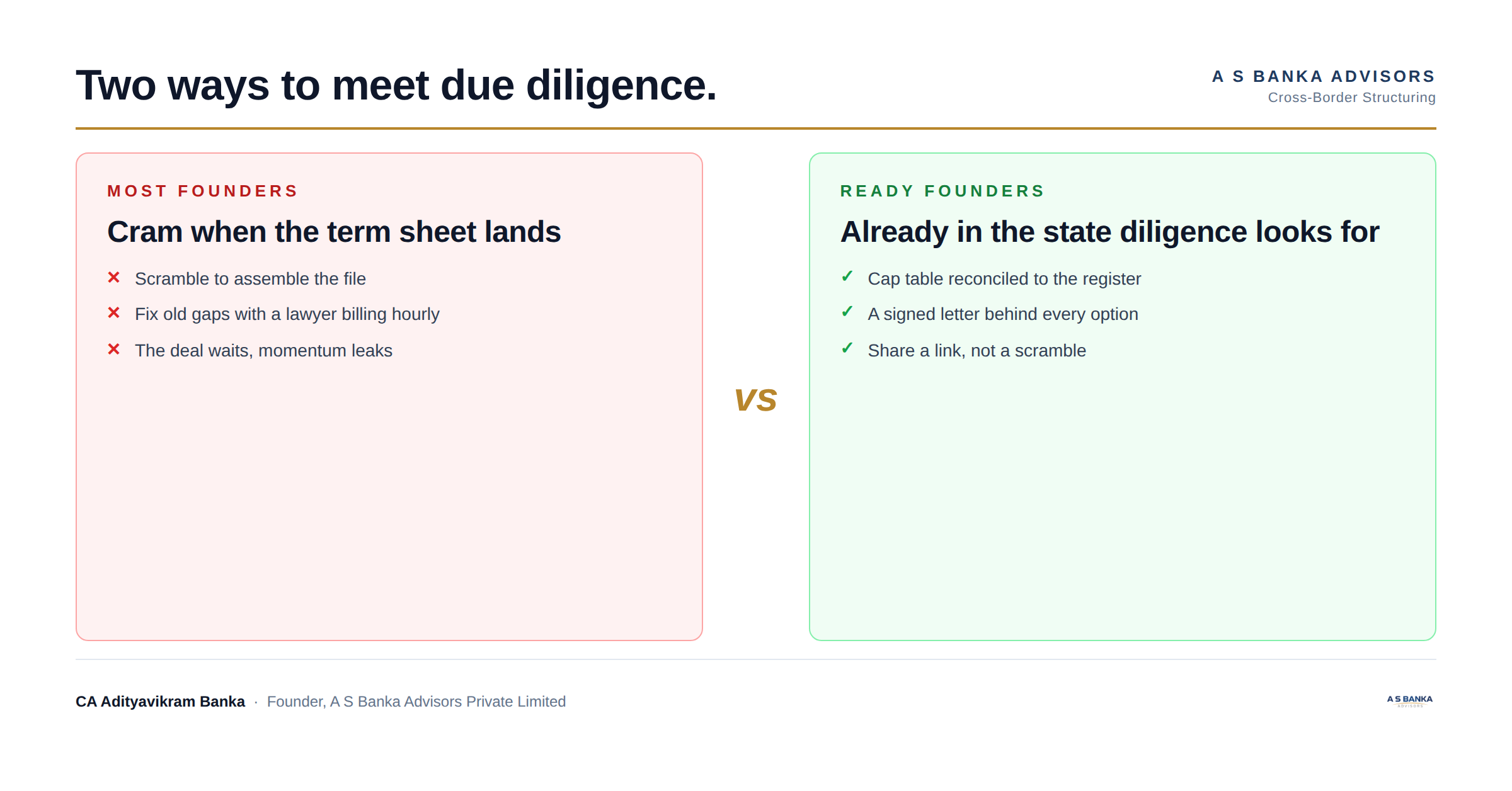
The Startup Due Diligence Checklist Indian Founders Should Run Before Investors Do
Key Takeaways Due diligence is a state, not an event.…
The 95-Document Due Diligence Checklist for Indian Startup Fundraising (2026)
Key Takeaways Series A due diligence typically reviews 80 to…