
What the IBC Amendment Bill 2025 Means for Your Business
On March 10, 2026, the Union Cabinet approved the Insolvency and Bankruptcy Code (Amendment) Bill, 2025, marking the most significant restructuring of India’s insolvency landscape since the IBC was originally enacted in 2016. For startups, corporate groups, and businesses with cross-border operations, this is not just a legal update; it is a fundamental shift in how financial distress will be resolved.
Three Reforms That Matter
1. CIIRP: A Faster, Less Adversarial Path
The new Creditor-Initiated Insolvency Resolution Process (CIIRP) creates an out-of-court mechanism for resolving financial distress. Unlike the existing CIRP, where a Resolution Professional takes control, CIIRP allows the debtor’s board to retain management. The timeline is capped at 150 days (extendable by 45 days), compared to CIRP’s potential 330-day window. Initiation requires 51% of notified financial creditors by debt value to agree.
For founders, this is significant: your management team stays in control while restructuring happens. For lenders, the streamlined process reduces resolution costs and timelines.
2. Group Insolvency: Coordinated, Not Consolidated
India’s first group insolvency framework takes a coordination-based approach. Each entity retains its separate legal identity while benefiting from a common NCLT bench, shared insolvency professionals, and joint creditor committees. This prevents the value destruction that occurs when interconnected group companies undergo separate, potentially conflicting insolvency proceedings.
For multi-entity startup groups and conglomerates, this framework offers a coherent resolution path that preserves group synergies during restructuring.
3. Cross-Border Insolvency: Finally, a Framework
The Bill introduces recognition of foreign insolvency proceedings, cooperation between Indian and foreign courts, and new Section 240C authorizing the Central Government to frame cross-border insolvency rules. Aligned with the UNCITRAL Model Law, this framework is expected to significantly boost confidence among foreign creditors and multinational enterprises with Indian operations.
If you have foreign investors on your cap table, this matters. Clearer cross-border dispute resolution reduces perceived risk for international capital.
Additional Changes Worth Noting
The Bill also clarifies that state and central authority claims require contractual agreements for secured creditor treatment, introduces provisions for asset transfer from guarantors to lenders during resolution, and decriminalizes 12 offences under the LLP Act.
What You Should Do Now
The Bill goes to Parliament for final passage, with implementation expected within 2026. In the meantime:
- Review your existing insolvency exposure and group structures
- Assess whether CIIRP could apply to any current distressed situations
- Brief your board and stakeholders on the new resolution options
- For cross-border operations, engage insolvency counsel early
Download the full carousel PDF for a detailed visual breakdown
Need help navigating the new IBC framework? Talk to an expert at A S Banka Advisors Private Limited
Related Posts

Startup Data Room Checklist: What Indian Investors Actually Ask For (2026)
Every founder thinks the raise starts with the pitch. It…
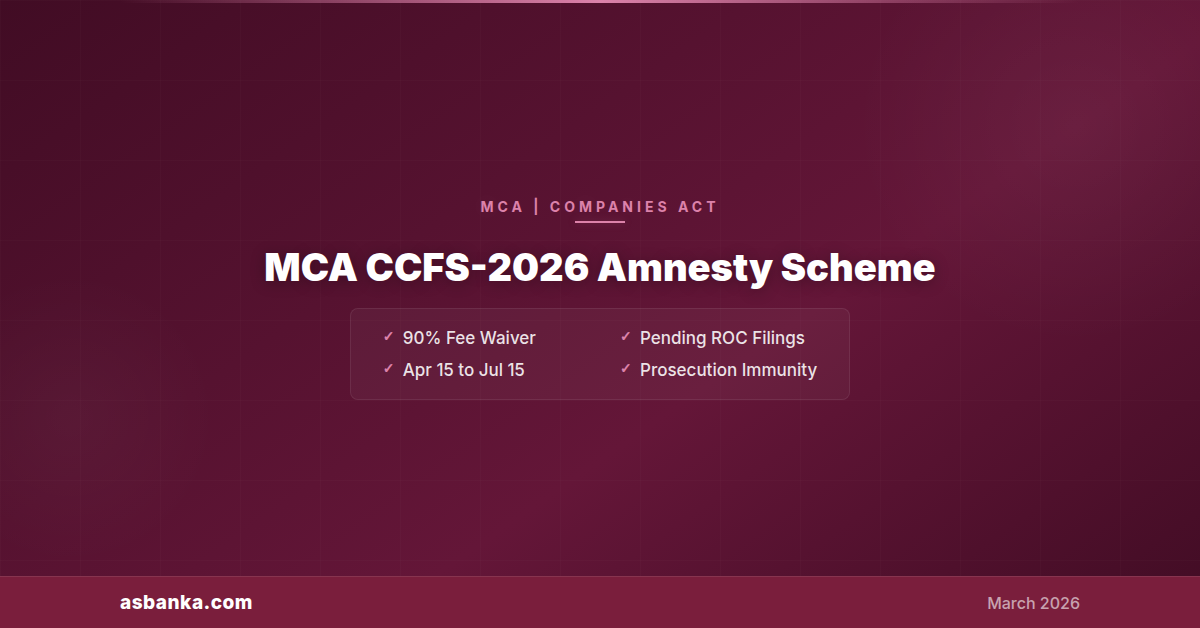
MCA CCFS-2026: How to Save 90% on Pending ROC Filing Fees Before July 15
If your startup has an inactive shell company on the…

The Startup Founder’s March 31 Compliance Checklist: 10 Deadlines You Cannot Miss
March 31 is the most consequential date on every Indian…